Rudolph P. Boshoff

Home/Rudolph P. Boshoff

About Rudolph P. Boshoff

This author has not yet filled in any details.
So far Rudolph P. Boshoff has created 328 blog entries.

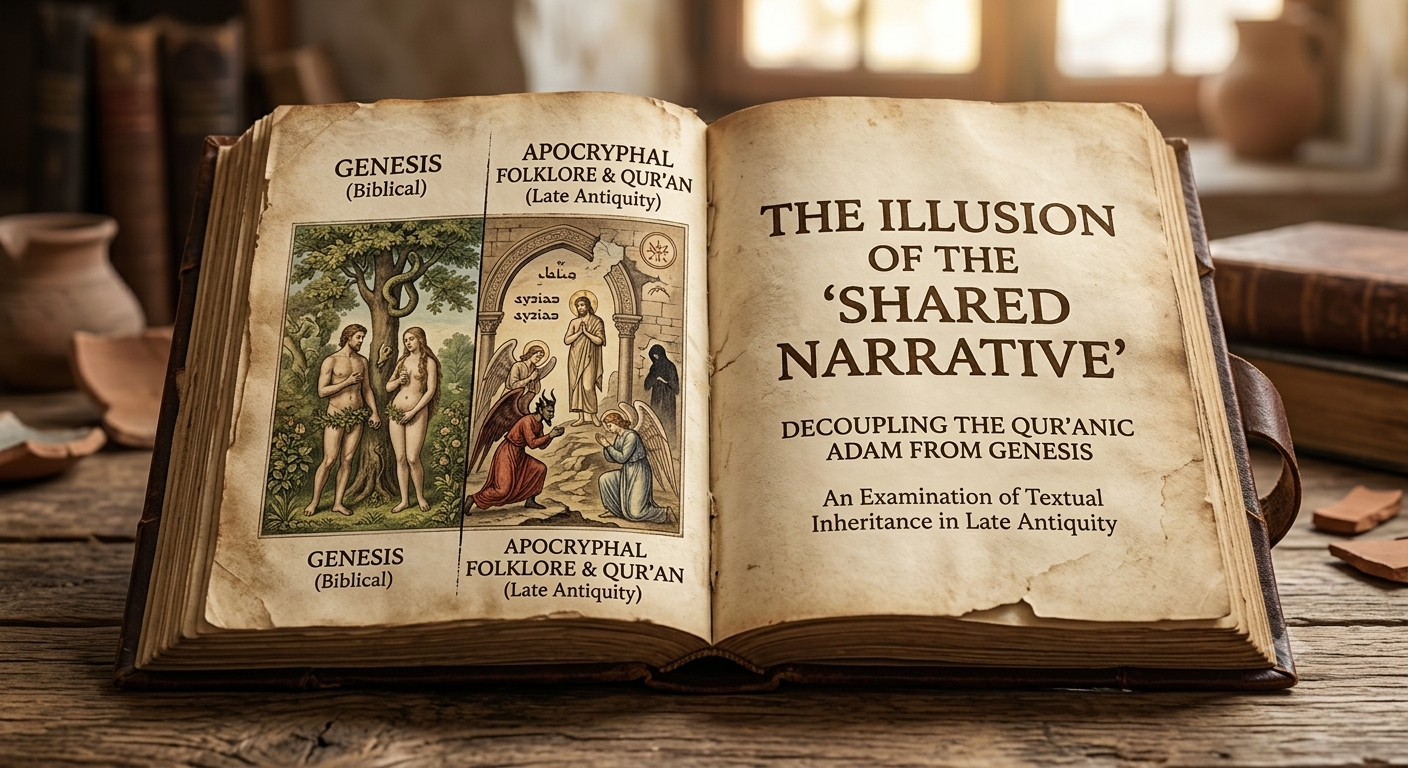
The Illusion of the “Shared Narrative”: Decoupling the Qur’anic Adam from Genesis by Rudolph P. Boshoff

In contemporary interfaith dialogue, a popular strategy for building common ground is to point to what appears to be a unified scriptural heritage. A prime example of this can be found in Dr. Osman Latif’s book, Divine Perfection: Christianity and Islam on Sin and Salvation. During discussions of the text—specifically the timestamp range 2:39–4:23—a foundational claim is made to establish a theological bridge between the two faiths under the banner of a "shared narrative". However, [...]

By |2026-07-08T14:32:43+02:00July 8th, 2026|Islam, Pagan Influence Theories|0 Comments

The Late Antique Milieu of the Qur’anic Adam and Eve by Rudolph P. Boshoff

There is no dispute that the Qur'an treats Late Antique Syriac and Rabbinic folklore as canonical history. Let's face it, if one is attempting to demonstrate a uniquely unmediated divine dictation, leaning heavily on the Life of Adam and Eve—a text that was essentially the theological fan-fiction of Late Antiquity—is a rather precarious position to take. The Late Antique Milieu of the Qur'anic Adam and Eve The Qur’an contains a repetitive but highly theological account [...]

By |2026-07-03T13:07:23+02:00July 3rd, 2026|Pagan Influence Theories|0 Comments

Short thoughts on the Qur’an an it’s rejection of Original Sin by Rudolph P. Boshoff

The Qur’an’s rejection of original sin (inherited ancestral guilt) and its specific construction of human accountability are not a historical vacuum or an unprecedented theological novelty. Instead, they map directly onto a fierce, pre-existing theological civil war raging across the Late Antique Near East. While Western Latin Christianity (following Augustine of Hippo) codified the doctrine of peccatum originale—the idea that humanity biologically or spiritually inherits Adam's moral guilt—the surrounding Rabbinic Jewish and East Syrian Christian [...]

By |2026-07-03T11:36:14+02:00July 3rd, 2026|Sin and Salvation|0 Comments

The God Who Feels: A Biblical Case for Divine Passibility by Rudolph P. Boshoff

Does God Really Suffer With Us? One of the most important debates in contemporary theology concerns the emotional life of God. Does God genuinely experience love, grief, compassion, delight, and sorrow in response to His creatures? Or is God utterly beyond all emotional change? For centuries, many Christian theologians affirmed the doctrine of divine impassibility, the belief that God cannot be affected by anything outside Himself and therefore cannot suffer or experience emotional changes. Classical [...]

Neo-Classical Theism vs. Classical Theism: Why the Classical View of God Faces Serious Challenges by Rudolph P. Boshoff

In the world of Christian philosophy and theology, few debates are as deep and enduring as the one between Classical Theism and Neo-Classical Theism. Classical Theism—shaped by giants like Augustine, Anselm, and especially Thomas Aquinas—presents God as the ultimate, unchanging, perfectly simple, timeless, and impassible Being. Neo-Classical Theism (sometimes called “modified classical theism”) seeks to preserve God’s core perfections while making room for a more relational, responsive, and dynamic picture of divinity.While both sides affirm [...]

By |2026-06-07T12:06:24+02:00June 4th, 2026|Divine Simplicity|0 Comments

William Hasker’s reply to Dale Tuggy on the denial of the Doctrine of the Trinity.

This document is a scholarly reply by William Hasker defending the historical development of the Trinity doctrine against Dale Tuggy's critique, emphasizing biblical and theological evidence. Disagreements on Definitions of Key Terms The author criticizes Tuggy’s problematic definitions of ‘unitarian’ and ‘trinitarian,’ arguing they distort historical and theological understanding. Tuggy’s broad ‘unitarian’ includes early theologians like Tertullian and Origen, despite their differing views, and his ‘trinitarian’ requires full ontological equality and identification of the Trinity [...]

By |2026-03-22T12:29:42+02:00March 22nd, 2026|Trinity, Unitarianism|0 Comments

20 Ways Cults Twist Scripture: A Biblical Response Inspired by James Sire

“How often have you encountered some bizarre doctrine only to be stunned to hear a Bible verse quoted to support it?” That question from James W. Sire cuts straight to the heart of a problem every Christian eventually faces: Scripture is not always denied, it is often misused. In fact, some of the most dangerous theological errors arise not from rejecting the Bible, but from twisting it. Sire’s work, Scripture Twisting, remains one of the [...]

By |2026-03-20T10:35:11+02:00March 20th, 2026|Christian Cults|0 Comments

Agency or Divinity? Why the Biblical Unitarian Argument About Jesus Falls Short by Rudolph P. Boshoff

In contemporary theological debates—especially online—Biblical Unitarianism has resurfaced as a serious challenge to historic Christian doctrine. One of its most common claims is that Jesus is not God but simply God’s appointed agent. According to this view, the exalted language used about Christ in the New Testament reflects delegated authority, not divine identity. At first glance, the argument appears persuasive. After all, Scripture repeatedly states that Jesus was sent by the Father and that He [...]

By |2026-03-07T10:22:26+02:00March 7th, 2026|Christology, Church History, Unitarianism|0 Comments

Jesus Across Time in the Gospel of John by Rudolph P. Boshoff

What if the Gospel of John presents Jesus not just as a historical figure, but as Lord over all time? When we read the gospel, we see that the author makes it abundantly clear that Jesus, in fact, did act in five places in history. In John’s Gospel, Jesus is revealed across five time horizons. As Andreas Köstenberger writes: “John presents Jesus as the eternal Son who transcends temporal categories, yet acts decisively within history.” — [...]

By |2026-02-18T10:17:08+02:00February 18th, 2026|Christology|0 Comments

Exploring Dietrich Bonhoeffer’s “The Cost of Discipleship”: Cheap Grace Versus Costly Grace by Rudolph P. Boshoff

Dietrich Bonhoeffer, the German Lutheran pastor and theologian executed by the Nazis in 1945 for his resistance to Hitler, wrote one of the most influential works on Christian living in the 20th century: The Cost of Discipleship (originally published in German as Nachfolge in 1937). Amid the rising tyranny of Nazi Germany and the complicity of much of the church, Bonhoeffer challenged believers to reject superficial faith and embrace radical obedience to Jesus Christ. At [...]

By |2026-01-21T08:27:28+02:00January 21st, 2026|Ecclesiology|0 Comments

Title

Go to Top