

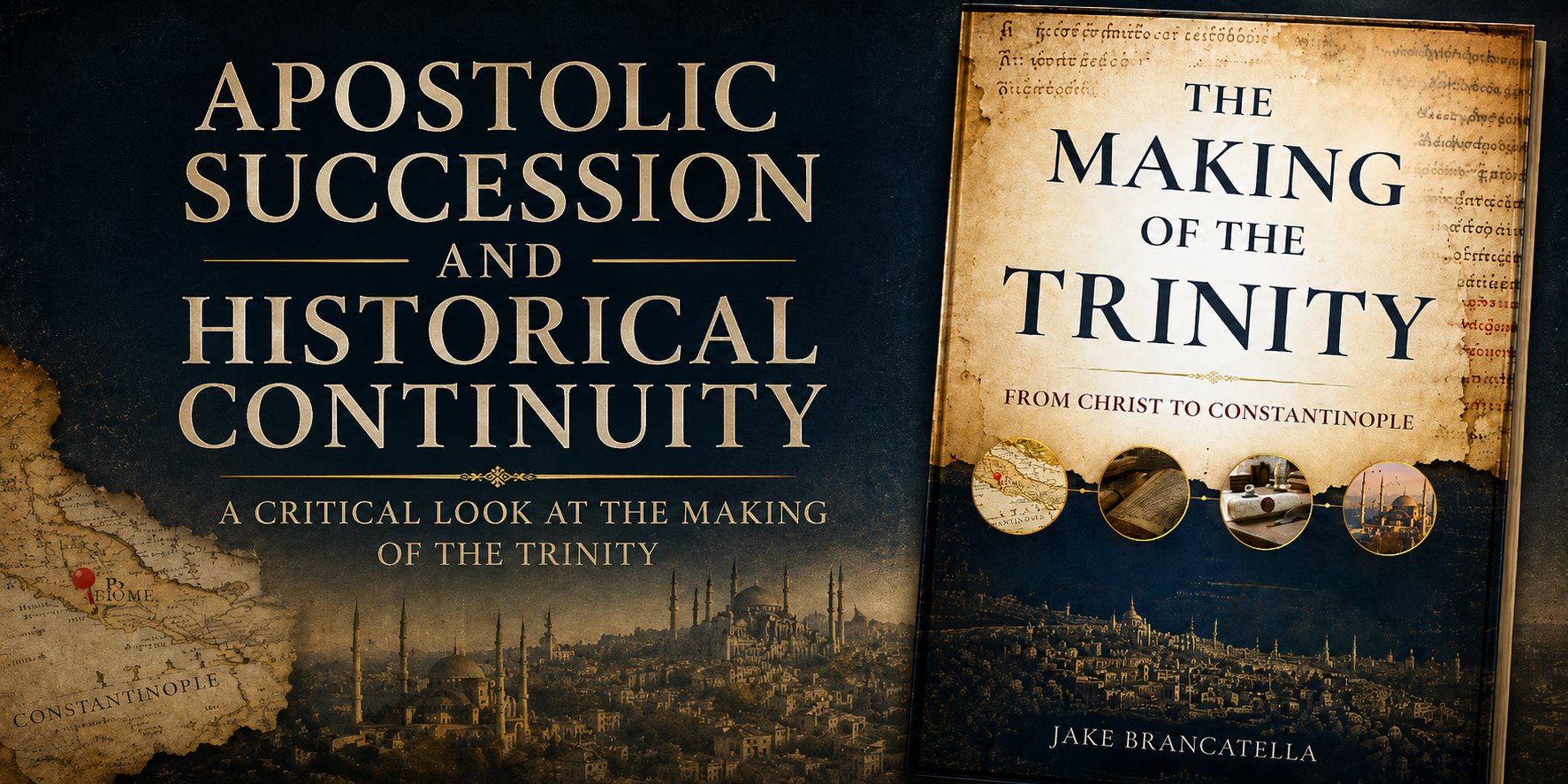
In 2022, I wrote an article on apostolic succession, particularly the rule of faith and the Old Testament’s eschatological expectation of the Messiah’s coming.
For me, one thing was certain: even Jesus’ earliest followers clearly anticipated the coming of the Messiah—the One appointed to set things in order and usher in the new hope of God’s Kingdom. The expectation was of Someone to come, but the shape and substance of that expectation were formed by the traditions, promises, and prophetic expectations of the Old Testament. In other words, the New Testament did not invent the Messiah; it announces that the One Israel had been waiting for had finally arrived. And apparently, He had a name.
That is why, when the Apostle Andrew found his brother Simon, he exclaimed, “We have found the Messiah” (that is, the Christ) (John 1:41, NIV).
John the Baptist similarly identifies Jesus as “the Lamb of God, who takes away the sin of the world” (John 1:29, NIV). Then, just a few chapters later, we find the Samaritan woman at the well explaining to Jesus, “I know that Messiah” (called Christ) “is coming. When he comes, he will explain everything to us.” Jesus responds rather remarkably: “I, the one speaking to you—I am he” (John 4:25–26, NIV).
In fact, the Gospels and the rest of the New Testament consistently present Jesus as the fulfilment of Israel’s messianic expectation and establish His place within the faith of the earliest Christian community. Jesus is not some theological surprise party that nobody saw coming. He is presented as the fulfilment of a story already deeply embedded in Israel’s Scriptures.
John even tells us that Isaiah “saw Jesus’ glory and spoke about him” (John 12:41, HCSB; cf. Isaiah 6). Likewise, Jesus is presented as “Ho Adon”; the coming Lord/Yahweh who comes to His people, preceded by John the Baptist (Matthew 3:1–12, HCSB). Jesus proclaimed, “For if you believed Moses, you would believe me; for he wrote of me (John 5:46, ESV).
And this is precisely why the discussion about apostolic succession cannot simply be reduced to the question, “Who ordained whom?” The more fundamental question is: What was handed down? The apostles were not merely passing along an institutional baton; they were proclaiming the fulfillment of an already established biblical expectation. The succession of the Church must therefore be understood in relation to the rule of faith, the apostolic proclamation, and the Old Testament story that finds its fulfillment in Christ. Otherwise, we risk making apostolic succession a rather impressive ecclesiastical relay race while forgetting what the runners were actually carrying. That is exactly why scholars like Richard B. Hays remind us that;
“The more deeply we probe the Jewish and Old Testament Roots of the Gospel narratives, the more clearly we see that each of the four Evangelists (and I would add the authors of the New Testament), in their diverse portrayals, identifies Jesus as the embodiment of the God of Israel.” (Pg 107).
Jake’s biggest weakness is that he seems to treat the “earliest Christian tradition” as though it can be reconstructed primarily from later ecclesial structures and patristic formulations like the early Church Councils, while neglecting the pre-existing biblical and Jewish framework that shaped the earliest Christian confession. The apostles did not begin with a blank theological slate: Israel’s Scriptures, the messianic hope, the rule of faith, and the expectation that Yahweh Himself would come to redeem His people shaped their understanding of Jesus.
So, before asking how later Christians understood apostolic succession, we must ask what the apostles themselves believed they had received and proclaimed. Otherwise, we risk reading later institutional developments backward into the earliest tradition, and calling the result “continuity” simply because it looks tidy on paper. Somewhat ironically, I think this section, written by Jake, creates a problem for his own historical argument.
That being said, Jake is absolutely right about one thing: Apostolicity mattered enormously to early Christians. Irenaeus appeals to the succession of bishops and to the churches founded by the apostles as evidence that the apostolic faith had been preserved. Tertullian makes essentially the same argument, challenging competing groups to demonstrate both their succession and their conformity to apostolic teaching. So far, Jake and I are getting along rather nicely…. But then things become rather more complicated.
Show me your bishop receipts
Jake’s presentation sometimes makes apostolic succession sound like an ancient ecclesiastical version of Ancestry.com: “Show me your bishop, and I’ll show you mine.” If you can produce a sufficiently impressive episcopal family tree going back to an apostle, apparently you’ve got yourself a theological trump card. But that isn’t quite how the early Christian argument works.
For Irenaeus, succession is not simply about possessing the correct episcopal genealogy. It is about continuity in apostolic teaching.
The succession matters because those ministers are supposed to preserve and transmit the apostolic rule of faith. Irenaeus therefore does not argue from the Apostles to the bishops, and therefore everything these bishops say is true. Nope… His argument was closer to: From the Apostles to the churches and faithful ministers, where there is preservation and public confession of apostolic teaching. That distinction is crucial. J. N. D. Kelly, one of the major twentieth-century historians of early Christian doctrine, describes the developing early Christian rule of faith as “the teaching inherited from the apostles.
That little phrase is enormously important. Inherited. As for what could be said about early Christian and them maintaining Apostolic teaching, Kelly writes;
While from the beginning the broad outline of revealed truth was respected as a sacrosanct inheritance from the Apostles, its theological explication was to a large extent left unfettered (Pg. 4).
The early Church did not understand itself to be inventing doctrine every time it formulated it more precisely. It understood itself as receiving something and then faithfully transmitting it. Kelly writes;
“the Apostles had committed [the teaching of Christ] … orally to the Church, where it had been handed down from generation to generation. Irenaeus believed that this was the case, stating that the Church preserved the tradition inherited from the apostles and passed it on to her Children [the Church]… (Pg. 37).
And that is precisely what makes apostolic succession relevant to the history of doctrine.
Irenaeus was not merely collecting bishop trading cards
Irenaeus’ argument makes particularly good sense when we remember the controversy he was actually addressing. The Gnostics were claiming access to superior or secret apostolic knowledge. Irenaeus’ response was effectively: “Wonderful. So where did the apostles teach this?” He appeals to the public teaching of the churches and to the succession of those who had received responsibility for those churches. He even appeals to Polycarp, whom he says the apostles taught and whom Irenaeus himself saw. This isn’t merely an episcopal genealogy. It is an argument about historical memory and the early rule of faith. Who received the teaching? Who taught the next generation? What did they teach? Did their teaching correspond to what the churches founded by the apostles had received? And that is precisely why Tertullian adds an important second criterion. After challenging heretics to produce their episcopal succession, he immediately argues that their doctrine itself will expose whether they actually descend from the apostles:
“their doctrine… will declare, by its own diversity and contrariety, that it had for its author neither an apostle nor an apostolic man.”
That is significant. Succession and doctrine belonged together. The early argument isn’t simply: “We have bishops.” No, it was rather an argument that said: “We have bishops who preserve the apostolic faith.”
Apostolic succession is not a theological force field
Jake actually notices something important here. He points to the Council of Chalcedon and correctly observes that bishops themselves could fall into error. Consequently, he concludes that apostolic succession is “not a guarantor of orthodoxy.” Quite right. But this doesn’t really damage the traditional argument. Nobody needs to claim that ordination gives a bishop a supernatural theological force field. (Even though that is what is promised by Jesus in the coming of the Holy Spirit, a.k.a. John 14:27). Church history would have disproved that proposition rather efficiently.
A bishop can possess legitimate ecclesiastical office and nevertheless teach error. That does not demonstrate that the office is meaningless. It shows that office and faithfulness are not identical. A corrupt judge doesn’t prove that judges don’t exist. He proves that judges can be corrupt. Likewise, a heretical bishop doesn’t disprove apostolic succession. It demonstrates that succession is not identical to personal infallibility. In fact, the very councils Jake discusses demonstrate this. The bishops at Chalcedon appeal repeatedly to Nicaea, Constantinople, Ephesus, Cyril, Scripture, and the earlier fathers because they understood their own theological task as one of continuity. They weren’t saying: “We’ve had a brilliant theological idea.” They were saying basically: “This is what the Church has received.” That distinction matters enormously.
The real problem: development versus invention
And here we arrive at the deeper issue. Jake’s methodology sometimes appears to assume that if a doctrine is genuinely apostolic, we should find earlier Christians expressing it in essentially the same conceptual form in which it was later defined. But that is not how historical doctrinal development normally works. J. N. D. Kelly’s description of early Christian doctrine is helpful precisely because he distinguishes between the faith received and the terminology used to explain it. In his discussion of doctrinal development, Kelly (Pg. 50) famously describes Vincent of Lérins’ principle as: “non nova, sed noue” (not new things, but in a new way) [emphasis mine].
That is a remarkably useful distinction. New terminology does not necessarily mean a new doctrine. A doctrine can be clarified without being invented. A concept can be defined without being created. A controversy can force the Church to say more precisely what it has already believed. And this is exactly what happened with Doctrines the Church held dear, like the Doctrine of the Trinity.
Nobody gave Justin Martyr a copy of Nicaea
Here is where I think we need to be particularly careful with historical expectations. Nobody expects Justin Martyr to sound exactly like Athanasius. Justin lived before Athanasius. Justin spoke in the “language of his time” about perceived conceptions of the people in his time. Nobody would expect him to sound like the rest, but they would expect him to preserve the core tenets of the faith, as for the rest…. We actually had a name for people that would cross the bounds of orthodoxy…we would call them heretics. That assumes that the first Christian communities had some idea what was believed. But nobody in history would expect Irenaeus to quote the Nicene Creed.
Irenaeus lived roughly two centuries before Nicaea. Nobody expects second-century Christians to use fourth-century theological terminology before fourth-century controversies forced the Church to develop it. That would be rather like complaining that Martin Luther did not use the phrase “Evangelical Free Church” because the denomination had not yet been invented. The absence of later terminology proves that later terminology had not yet been formulated. It does not prove the absence of the theological substance that the terminology eventually described.
Kelly makes precisely this broader point in his treatment of early Christian theology. He describes the early period as one of genuine doctrinal development and notes that the Church’s later formulations emerged as inherited convictions were increasingly clarified and expressed (Pg. 29–35). Indeed, Kelly’s stated purpose in Early Christian Doctrines was to trace the development of the principal Christian doctrines from the post-apostolic period through Chalcedon. Notice the word development…. Not invention.
This makes Jake’s own use of Chalcedon particularly interesting. He quotes Chalcedon emphasizing its continuity with the earlier councils and creeds. Chalcedon explicitly appeals to Nicaea and Constantinople and describes its confession as consistent with what came before. Now, obviously, saying that a council claimed continuity doesn’t automatically prove that it actually achieved continuity. But historically, we cannot simply ignore the claim. The historian has to ask: Why did these Christians believe that they were continuing the apostolic faith? And then: Was their claim historically plausible? That is a much more interesting question than simply asking whether fourth-century Christians used fourth-century vocabulary in the second century.
The rule of faith is the missing piece
This is where Kelly becomes particularly useful. The second-century Church increasingly appealed to what was called the regula fidei, the “rule of faith.” Kelly describes it as: “the teaching inherited from the apostles and set out in freely worded summaries” (Pg.39–40; 43–44; 192). That phrase deserves to be underlined. “Inherited from the apostles.” Notice also: “freely worded summaries.”
There we have almost the entire problem in miniature. The faith is inherited. The wording can develop. That means historical continuity does not require verbal uniformity. And this is precisely where some arguments against Nicene theology become unnecessarily rigid. They assume that if the terminology changes, the doctrine must have changed. But that doesn’t follow. The question should instead be: Does the later formulation faithfully explicate the earlier Christian confession? That’s a legitimate historical question. And it is considerably more difficult than simply asking whether Justin Martyr would have passed a fourth-century Nicene theology exam.
Apostolic succession is therefore more complicated—and more useful
Apostolic succession, properly understood, doesn’t mean: “Every bishop is infallible.” Nor does it mean: “Whatever the bishops eventually say must be apostolic.” It means that the early Church understood itself as standing within a historical continuity of apostolic teaching, ministry, worship, Scripture, and ecclesial life. The succession of ministers was one part of that larger continuity. This is why Irenaeus can appeal to succession while simultaneously appealing to doctrine. Tertullian can challenge the heretics on their succession while also testing their theology against apostolic teaching. The succession isn’t a substitute for the apostolic faith. It is evidence for its historical transmission.
And that distinction makes the argument considerably stronger. So what is the actual historical question? This, I think, is where the debate ultimately needs to land. The question is not: “Did second-century Christians already possess the Nicene Creed?” Of course they didn’t. A way more reasonable and historical question is: “Can the Nicene confession be understood as the legitimate development and clarification of the apostolic faith preserved in the earlier Church?” That’s the historical question.
And once you ask it that way, the evidence becomes much more complicated for the “late invention” thesis. The second century gives us the apostolic rule of faith. Irenaeus gives us continuity of apostolic teaching and episcopal succession. Tertullian gives us the relationship between succession and doctrinal conformity. The fourth century gives us increasingly precise language concerning the Father, Son, and Spirit. Nicaea gives us “homoousios” [same not similar substance] as a weapon against a particular understanding of the Son. Constantinople further develops the Church’s confession concerning the Holy Spirit.
Chalcedon then does something similar with Christology. That looks an awful lot like doctrinal development. It does not automatically prove that every later formulation is correct. But it does make the claim that Nicene Christianity was simply invented in the fourth century harder to sustain.
The problem with [Jake’s] the historical test
Ultimately, I think Brancatella’s treatment of apostolic succession exposes a methodological problem that runs through the larger discussion. If the standard is: “Show me a second-century Christian who expresses fourth-century Nicene theology with fourth-century precision,” then the historical argument has already rigged the courtroom. But if the standard is: “Show me whether there is a coherent historical trajectory from the apostolic proclamation through the early Church into the later doctrinal formulations,” then we are having a much more serious conversation.
Because development is not the enemy of continuity. In fact, development is precisely what we should expect when the Church takes inherited theological convictions and, forced by controversy, explains exactly what they mean. Kelly actually makes that exact point! And even in Islam, the doctrine of Tawheed “developed”… Doctrine becomes clearer. The vocabulary becomes sharper. The distinctions become more precise. And sometimes the Church has to spend several centuries arguing about one Greek word. Because apparently Christians can turn a perfectly respectable noun into a four-hundred-year ecclesiastical crisis. But that is not necessarily evidence that the doctrine itself was invented. It may be evidence that Christians were trying very, very hard to preserve what they believed they had received. And that, ironically, is exactly why apostolic succession matters.
The question is not whether the Church developed. The question is whether it developed away from the apostles—or deeper into the implications of what it believed the apostles had given it. That is the historical question Jake needs to answer. And simply pointing out that bishops sometimes got things wrong doesn’t get him there.
Sources
- J. N. D. Kelly, Early Christian Doctrines, 5th ed. London: A&C Black, 1977.
- Henry Chadwick, The Early Church. London: Penguin, 1967.
- Irenaeus, Against Heresies, especially 3.3 and 4.26.
- Tertullian, The Prescription Against Heretics, 32.
- Council of Chalcedon, Definition of Faith (451).
- Richard B. Hays, Reading Backwards: Figural Christology and the Fourfold Gospel Witness, Baylor University Press. 2014.

Leave A Comment