

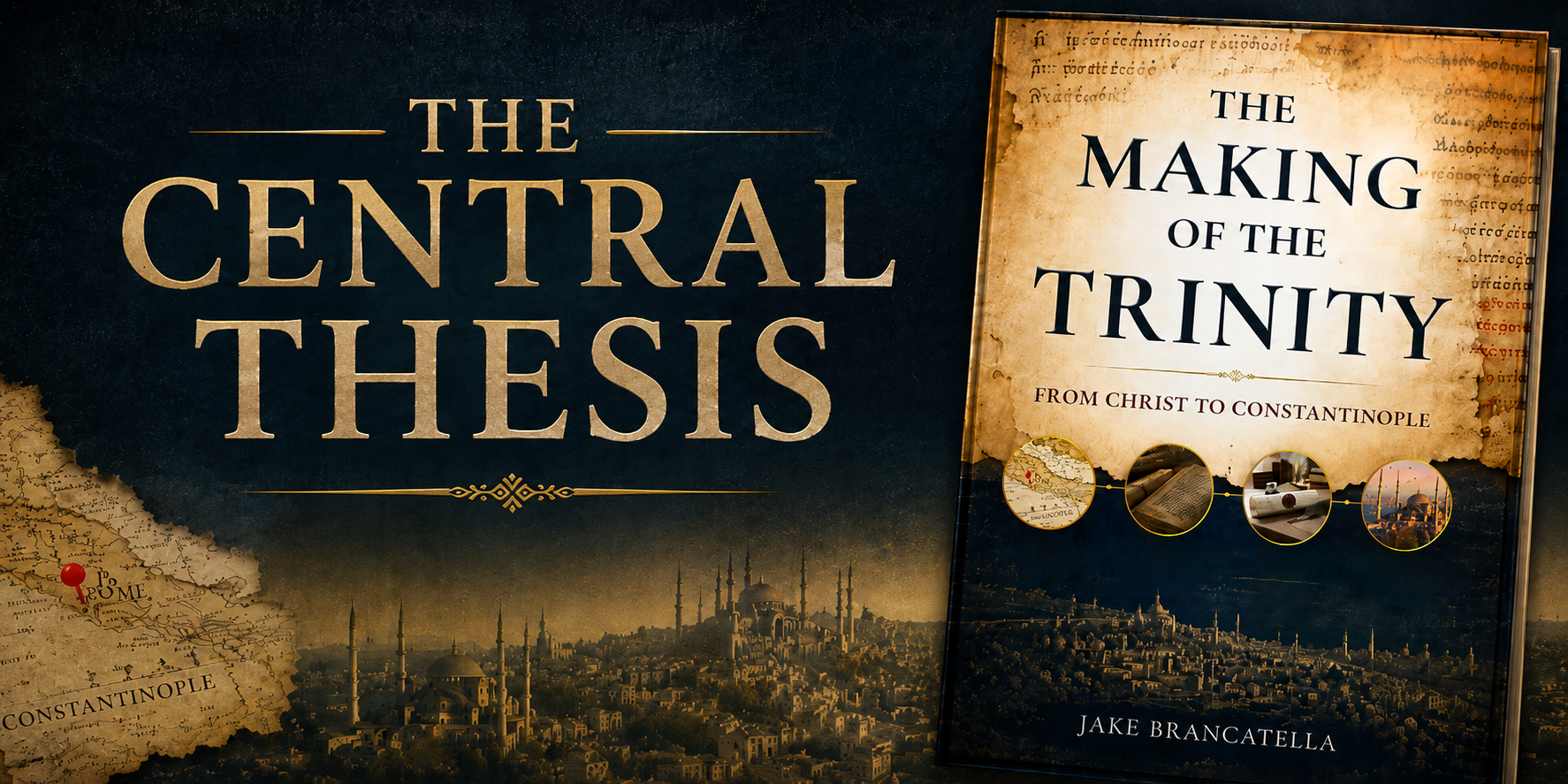
There is a particular argument against the Christian doctrine of the Trinity that sounds rather impressive when delivered with enough confidence, enough footnotes, and preferably a photograph of an ancient manuscript somewhere in the background. The argument goes something like this: If Jesus taught the Trinity, and if the Bible clearly teaches the Trinity, then Christians in the first three centuries should have been Trinitarians. But we supposedly do not find Trinitarians in those first three centuries. Therefore, Jesus did not teach the Trinity, and the Bible does not clearly teach it. At first glance, this looks like a devastating historical argument. Unfortunately, once we actually open the historical sources, the argument begins to wobble rather badly. And by “wobble,” I mean it eventually falls over the stairs.
The central thesis rests upon a fundamental confusion between the development of theological terminology and the development of theological belief. It assumes that unless second- and third-century Christians articulated the doctrine of the Trinity using the vocabulary and conceptual precision that emerged at Nicaea and after, the doctrine itself must have been absent. That assumption is historically and philosophically unsustainable. The Trinity was not invented at Nicaea. The terminology became more precise at Nicaea because Christians had already been wrestling with the biblical identity of the Father, Son and Holy Spirit for centuries. That distinction changes everything.
The Central Thesis
The argument can be formalised as follows:
P1. If Jesus and the Bible clearly taught the doctrine of the Trinity, then we should find Trinitarians in the first three centuries after Jesus.
P2. We do not find Trinitarians in the first three centuries after Jesus.
C. Therefore, Jesus and the Bible did not clearly teach the doctrine of the Trinity.
The first thing we should say is that the argument is formally valid. But, and this is a rather large but, a valid argument is not necessarily a sound argument. If the premises are false, the conclusion doesn’t magically become true because the syllogism is wearing a tie. The entire case therefore hangs on P2:
“We do not find Trinitarians in the first three centuries.”
That statement is simply historically false if “Trinitarian” means Christians who confess one God while affirming the divine status of the Father, Son and Holy Spirit and distinguishing them from one another. And if “Trinitarian” is defined so narrowly that it means only someone who possesses the fully developed theological vocabulary of the fourth and fifth centuries, then the conclusion becomes circular. You define “Trinitarian” as someone who believes the later formulation and then announce… “Look! Early Christians weren’t Trinitarian because they didn’t have the later formulation.” Well, yes. But that is rather like announcing that Shakespeare wasn’t an Elizabethan novelist because he never wrote a book called Elizabethan Novels. The terminology is doing all the heavy lifting.
The Fundamental Category Error: Doctrine Versus Terminology
This is the first major problem. The doctrine of the Trinity and the technical formulation of the Trinity are not identical things. The word Trinity is not found in the New Testament. Neither are homoousios, hypostasis in its later technical usage, perichoresis, or the sophisticated metaphysical distinctions developed by later theologians. But the absence of a later technical word does not entail the absence of the theological reality that the word eventually describes. This is basic intellectual history. The Church did not begin with a philosophical definition and then go searching for Bible verses to justify it. Rather, Christians inherited a collection of biblical claims that had to be held together:
- God is one.
- The Father is God.
- Jesus is identified in divine terms.
- The Son is distinct from the Father.
- The Holy Spirit acts personally and divinely.
- Father, Son and Spirit are repeatedly placed together in Christian worship and salvation.
The theological question therefore became: How can all these biblical claims be affirmed simultaneously without either abandoning monotheism or denying the identity of the Son and Spirit? That is the Trinity question. The fourth century did not invent the question. The New Testament created the problem. (And by problem I do not mean fatally flawed or not valid). Nicaea was one major stage in the Church’s attempt to answer it.
The New Testament Already Gives Us the Problem
Before we even reach the Church Fathers, the argument has to deal with the New Testament itself. Christianity inherited an uncompromising Jewish monotheism. Deuteronomy 6:4 declares:
“The LORD our God, the LORD is one.”
Yet the New Testament makes extraordinary claims about Jesus. John begins his Gospel:
“In the beginning was the Word, and the Word was with God, and the Word was God.”
That sentence is doing quite a lot of theological work in only a few words. The Word is with God, distinction. The Word was God, divine identity. John does not appear to be particularly worried about making our lives easy. Then Thomas encounters the risen Christ and says:
“My Lord and my God!” (John 20:28).
Paul describes Christ in Philippians 2 in language of pre-existence, divine status, incarnation and universal homage. Colossians 1 presents Christ as the one through whom all things were created. Hebrews 1 applies Old Testament divine language to the Son. And the Holy Spirit is not treated merely as an impersonal divine electricity. The Spirit speaks. The Spirit teaches. The Spirit can be grieved. The Spirit searches the depths of God. The Spirit distributes gifts according to his will. Then Matthew 28:19 places Father, Son and Holy Spirit together within the singular baptismal “name.” And Paul closes 2 Corinthians with a triadic benediction involving: the Lord Jesus Christ, God, and the Holy Spirit. So the Christian Church inherited an obvious theological puzzle. Not: “Should we believe in one God or three?” But: “How do we confess one God while faithfully affirming everything Scripture says about Father, Son and Spirit?” That is a much more difficult, and much more interesting, question. “Nobody Noticed” Is Historically Difficult to Maintain… The central thesis claims that if Scripture clearly teaches the Trinity, we should find early Christians interpreting Scripture that way. Excellent. Let’s do exactly that. The historical evidence does not give us a three-hundred-year black hole. Quite the opposite. We find a gradual development of increasingly explicit Trinitarian language. And that development is precisely what we would expect. A Key figure in this conversation is the early Apologist for Christianity, Dr Justin Martin…I mean, Martyr ( I wonder how he died).
Justin Martyr: The Second Century Is Already Talking
Justin Martyr lived approximately AD 100–165. He is therefore not exactly a fourth-century Christian sneaking into the historical record after the theological police have already done their work. In his First Apology, Justin describes Christian baptism in the name of God the Father, Jesus Christ, and the Holy Spirit. More significantly, Justin speaks of Christians worshipping the Father, the Son, and the prophetic Spirit. (New Advent) Justin’s theology is not identical to the later Nicene formulation. And we should not pretend it is. Neither is it what we expect when we read his works. He uses concepts and categories that later theologians would refine considerably. But that is precisely the point. The question isn’t whether Justin sounds like Athanasius. He doesn’t. The question is whether Justin exhibits the theological trajectory from which Nicene Trinitarianism develops. He certainly does. And Justin is only a second-century witness. The alleged three-century silence that the author of the book would want to sell us has already become rather flimsy. Especially when you consider yet ANOTHER early Christian’s opinion.
Irenaeus: One God, Father, Son and Spirit
Then we come to Irenaeus of Lyons, writing in the second century. Irenaeus emphatically maintains monotheism. He speaks of the one God, the Creator, and identifies the Father as God. But he also speaks of God’s activity through the Word and the Holy Spirit (New Advent). Even more importantly, Irenaeus identifies the Son in divine terms. In his writing called Against Heresies, Chapter 3 ayat 6 (tsk tsk), he argues from Scripture that the Father and Son are truly Lord, while also discussing the Holy Spirit in relation to them (New Advent). Again, Irenaeus is not writing the Nicene Creed. But neither is he preaching Islamic Tawhid. He is trying to explain the Christian confession of one God in relation to Father, Son and Spirit. And he does this more than a century before Nicaea. That really matters. Another key thinker in my opinion is Hippolytus.
Hippolytus: The Argument Gets Awkward
Then we reach Hippolytus, probably writing in the early third century. And here the argument becomes downright uncomfortable. In Against Noetus, Hippolytus explicitly speaks of:
- God the Father,
- Christ Jesus the Son, who is God,
- and the Holy Spirit.
Then he says: “these, therefore, are three.” Yet he immediately insists: “there is one God” (New Advent). And Hippolytus does something even more devastating to the thesis. He explicitly connects his argument to John 1:1: “the Word was with God, and the Word was God.” He then distinguishes Father and Son without concluding that Christianity therefore has two gods. He also connects the theological pattern to Matthew 28:19 and Father, Son and Holy Spirit. (New Advent). In other words, here we have an early Christian theologian doing precisely what the argument says should not exist: an early Christian interpreting Scripture in a way that distinguishes Father, Son and Spirit while maintaining monotheism. The historical evidence has now gone from whispering to shouting. I am looking at but a few of the pre-Niceaen thinkers. And here also Tertullian.
Tertullian: The Smoking Gun
Then we get to Tertullian. Tertullian wrote Against Praxeas around the beginning of the third century, approximately AD 200–220. And Tertullian uses the language of the Trinity. He speaks of one divine substance and three Persons, while arguing against modalism—the idea that Father and Son are simply different modes or manifestations of the same Person (Tertullian Project). This is enormously significant. Why? Because Tertullian isn’t merely saying: “Father, Son and Holy Spirit are mentioned together.” He is explicitly addressing the theological relationship between them. He argues that the Father and Son are distinct without dividing the unity of God. Modern scholarship has rightly cautioned that Tertullian’s substantia and persona should not simply be loaded with all the later Nicene and Cappadocian meanings. His vocabulary belongs to his own theological and philosophical context. (SciELO) But again: that actually helps our argument. Because it demonstrates that the terminology was developing. The later Church did not invent the subject. It inherited the discussion.
The Trinity Was Not Invented at Nicaea
This is one of the most persistent myths that needs to die a peaceful death. The Council of Nicaea met in AD 325 primarily in response to the Arian controversy. Arius denied that the Son was eternal in the same sense as the Father and argued that the Son was a creature. The Nicene response was to insist that the Son is homoousios, of the same substance/essence, with the Father. But Nicaea did not invent the idea that the Father and Son were divine. Nor did it invent the idea that the Father, Son and Spirit were distinguishable. Those ideas had been discussed for generations. Nicaea gave the Church a more precise doctrinal boundary. That’s different. A council can define a doctrine more precisely without creating the underlying belief from nothing.
Doctrinal Development Is Not Doctrinal Fabrication
This distinction is crucial. There is a world of difference between: “The doctrine developed” and “The doctrine was invented.” Every serious theological tradition experiences development. Consider Christology. The New Testament calls Jesus: Messiah, Lord, Son of God, Word, Son of Man, image of God, and God.
But it does not hand us a neatly formatted fifth-century Christological definition saying: “Jesus Christ is one Person possessing two natures, fully divine and fully human, without confusion, change, division or separation.” That formulation comes later. Why? Because Christians had to work through difficult questions. Was Jesus truly God? Was he truly human? How do those two realities relate? Did his humanity diminish his divinity? Did his divinity swallow his humanity? The Church eventually developed increasingly precise language. We do not conclude: “Therefore Jesus was invented at Chalcedon.” That would be absurd. So why employ precisely that logic against the Trinity?
The Historical Argument Proves Far Too Much
This is where the argument becomes philosophically self-destructive. If the principle is: “A doctrine cannot be biblical unless Christians articulated it in its mature technical form immediately,” then we have a serious problem. Where is the fully developed doctrine of:
- Christ’s two natures?
- the hypostatic union?
- the precise boundaries of the biblical canon?
- the formal doctrine of justification?
- the doctrine of divine simplicity?
- the technical distinction between nature and person?
These concepts developed over time. And rightly so. Why? Because Scripture provides theological data, and theology seeks conceptual coherence. The existence of later terminology therefore tells us something about the history of theological reflection. It does not, by itself, tell us that the underlying belief was fabricated.
The Central Thesis Also Misunderstands What Nicaea Was Doing
Nicaea was not a committee meeting where the bishops sat around a table and voted: “Right, lads, today we shall manufacture a Trinity.” The bishops were confronted by a dispute over the identity of Christ. Arius claimed the Son was created. Others insisted that the Son belonged within the unique divine identity. The question was therefore: What does Christian worship of Jesus mean if there is only one God? That question had existed long before AD 325. Nicaea didn’t create the question. Nicaea inherited the question. And the answer was shaped by Scripture, previous Christian confession, and the Church’s ongoing theological reflection. It should be noted that Early Christianity was not a Theological Monolith. And that is ok. Now, let’s be fair. There were plenty of early Christians who did not articulate Trinitarian theology in the later orthodox form. There were competing Christologies. There were modalists. There were adoptionists. There were various Gnostic groups. There were different approaches to the relationship between the Father and Son. There were also forms of subordinationism that require much more nuanced discussion than simply saying: “They were all Trinitarians.” They weren’t. But here is the important point: Diversity does not equal absence.
In fact, the very existence of the controversies demonstrates that early Christians were wrestling with the identity of Christ and his relationship to the Father. Hippolytus is writing against Noetus. Tertullian is writing against Praxeas. Irenaeus is writing against competing Christologies. The Church is not sitting around for three hundred years saying: “Jesus was a nice prophet. Anyway, anyone seen my sandals?” They are arguing furiously about who Jesus is. It should be noted that the Trinity emerged from a Biblical tension! This is perhaps the strongest way to understand the doctrine. The Trinity is not based on one magical verse. Theology is not conjuring… It emerges from the convergence of multiple biblical claims.
Claim One: God is one. Isaiah (45:5) repeatedly insists that there is no God besides Yahweh. Paul remains uncompromisingly monotheistic.
Claim Two: The Father is God. Nobody seriously disputes this.
Claim Three: The Son participates in divine identity (John 1:1, John 20:28, Philippians 2, Colossians 1, Hebrews 1). And numerous other explicit, non-negotiable texts.
Claim Four: The Son is distinct from the Father; Jesus prays to the Father. The Father sends the Son. The Son returns to the Father. The Son loves the Father. The Father loves the Son. The distinction is relational, not merely linguistic.
Claim Five: The Spirit is divine and personal. The Spirit speaks. The Spirit is distinct from the Angel Gabriel (debate) and Muhammad. The Spirit wills. The Spirit teaches. The Spirit intercedes. The Spirit can be grieved.
Claim Six: Father, Son, and Spirit appear together (Matthew 28:19, 2 Corinthians 13:14, 1 Peter 1:2). And so forth. Now put those claims together. You have a theological problem. And the Trinity is Christianity’s attempt to solve the problem without sacrificing any of the biblical premises.
Taken together, a clear, probable Biblical picture seems to emerge. Doctrine is the collective attempt to make sure what we say affirms the Biblical imperatives; historical claims are secondary and, as we have seen, complementary to the biblical demands, not the interpreter of it.
The Trinity Is Not “Three Gods”
This is another place where the Christian doctrine is frequently caricatured. Classical Trinitarianism does not say:
Father = God
Son = God
Spirit = God
Therefore Father + Son + Spirit = three Gods.
That would indeed be tritheism. The doctrine says something much more nuanced: There is one divine being/essence and three distinct Persons.
Now, whether one finds that metaphysical account convincing is another discussion. But it is intellectually dishonest to attack Christianity for believing something Christianity does not actually believe. The doctrine is not:
1 + 1 + 1 = 3 gods.
It is a claim about divine being and personal distinction. And that distinction is precisely what fourth-century theology worked painstakingly to clarify. The “Nobody Noticed” Argument is therefore backward and flawed. The argument says: If the Bible clearly taught the Trinity, someone should have noticed. But people did notice (No surprise here). What they didn’t possess immediately was the fourth-century vocabulary with which to express the doctrine with maximum philosophical precision. And there is nothing surprising about that. The better historical model is:
New Testament revelation → early Christian confession → theological reflection → controversy → conceptual clarification → conciliar formulation.
Not:
New Testament → silence for 300 years → Constantine invents Trinity.
The second model makes for excellent YouTube thumbnails. The first model happens to fit the historical evidence considerably better. What is important then is to consider the contribution Tertullian made! Consider what Tertullian tells us. He argues that Christians believe in one God, but that the divine economy involves Father, Son, and Spirit. He explicitly addresses the charge that distinguishing the three somehow introduces a plurality of gods (Tertullian Project). That is fascinating because it shows us that the central Trinitarian problem was already recognized: How do you distinguish Father, Son and Spirit without destroying monotheism? That is basically the Trinity debate. Not perfectly formulated. Not yet Nicene. But unmistakably the same theological problem. So when someone says: “Nobody was asking this question before Nicaea,” we can respond: Well, Tertullian was. And Hippolytus was. And Irenaeus was. And Justin was. And the New Testament authors were already giving Christians the data that generated the question. The supposed historical vacuum simply isn’t there.
The Argument Also Smuggles in a Problematic Definition of “Clearly”
There is another issue. The argument repeatedly speaks about the Bible “clearly teaching” the Trinity. But what does clearly mean? Does it mean: “The Bible contains a sentence saying, ‘God is one being existing eternally as three co-equal, co-eternal Persons’”? If that’s the standard, then no, Scripture does not give us that sentence. But that’s not how theological doctrines normally work. The doctrine of the Trinity is a synthetic doctrine. That means it is derived by putting multiple biblical propositions together.
The Bible does not need to contain the sentence: “The Trinity is one essence in three Persons.” for the doctrine to be biblical. The question is whether the doctrine faithfully synthesises the biblical evidence. That is a legitimate theological debate. But it is completely different from saying: “The word Trinity isn’t in the Bible, therefore the doctrine isn’t biblical.” That is merely a lexical fallacy wearing academic clothing. The early Fathers don’t give us a single perfectly uniform doctrine. And we should resist the temptation to turn them into miniature fourth-century Nicene Christians. But they do demonstrate several important things.
First, early Christians were committed to monotheism. Irenaeus is emphatic about one God (New Advent)
Second, Christ was being given an extraordinarily high theological status. Irenaeus speaks of Christ in divine terms (New Advent). Hippolytus explicitly calls Christ God. (New Advent)
Third, Father, Son and Spirit were treated together in Christian theology and practice. Justin’s baptismal description demonstrates this (New Advent).
Fourth, Christians were already debating how Father and Son could be distinct without creating two gods. Hippolytus and Tertullian make this unmistakable (New Advent).
Fifth, by the early third century, Tertullian is using explicit Trinitarian terminology. That is simply historical evidence (Tertullian Project). So the claim that we have to wait until the fourth century to discover Trinitarian thought simply does not survive contact with the sources.
“But They Were Not Nicene!”
Correct. And that objection proves my point rather than defeating it. The Fathers were pre-Nicene. That’s why they don’t sound exactly Nicene. Tertullian is not Athanasius. Justin is not Basil. Irenaeus is not Gregory of Nazianzus. Hippolytus is not Augustine. Why would they be? They lived generations earlier. The development of theological language is precisely what we would expect when Christians move from confession to conceptual clarification. The mistake is assuming: “If doctrine X exists in mature form in AD 325, it must have existed in exactly the same linguistic form in AD 100.” That is not historical reasoning. That’s a time machine. And historians generally prefer not to use those.
The Islamic Narrative Does Not Rescue the Argument
The argument is careful to say that it does not claim the early Church Fathers were Muslims. Fair enough. But then it says that the evidence is consistent with the Islamic narrative. That is true in a very limited sense. Almost any historical evidence can be described as “consistent with” a later theological narrative if that phrase is sufficiently elastic. The problem is that consistency is not demonstration. The fact that an early Christian writer does not use Nicene terminology does not establish that Muhammad’s later theological account of Jesus is therefore correct. Islam emerges in the seventh century. The Christian sources under discussion are centuries earlier.
So the historical question remains. What did the earliest Christian communities actually believe about Jesus? And when we examine those sources, the picture is not of Christians patiently preserving a simple Islamic-style prophetic Christology until the seventh century. It is a picture of Christians confessing Jesus as Lord, Messiah, Son and divine figure, worshipping him, baptizing in the triadic name, and wrestling intensely with how that confession relates to Jewish monotheism. That historical reality deserves to be confronted rather than bypassed.
The Real “Making” of the Trinity
If we want to use the phrase “the making of the Trinity,” we should use it carefully. There was indeed a making of the Trinity in one sense. The Church made a theological formulation. It made distinctions. It developed vocabulary. It clarified concepts. It defined what it meant by person, essence, nature, substance and related terms. It drew boundaries against competing interpretations. But that is very different from saying: The Church invented the Trinity in the fourth century. The better historical description is: The Church progressively formulated the doctrine of the Trinity in response to the biblical witness and the theological controversies generated by that witness. That is a very different claim. And it is much closer to the historical evidence.
The Central Thesis Therefore Fails
We can now return to the original syllogism.
P1: If Jesus and the Bible clearly taught the Trinity, then we should find Trinitarians in the first three centuries.
Reasonable, provided “Trinitarian” means theologically substantive Trinitarian belief rather than fourth-century vocabulary.
P2: We do not find Trinitarians in the first three centuries.
False Jake… Justin, Irenaeus, Hippolytus and Tertullian provide substantial evidence of early Christian reflection on Father, Son and Holy Spirit within a monotheistic framework. Tertullian explicitly uses Trinitarian terminology by the early third century (New Advent). The conclusion therefore is…..
Jesus and the Bible did not teach the Trinity. Does not follow, because P2 is false. The argument collapses. Not because Christians have cleverly invented a new argument. Not because we can simply shout “Nicaea!” and declare victory. But because the historical premise does not survive examination. Finally! The Trinity Wasn’t Smuggled in Through the Back Door
The most important distinction is this: The Trinity was not suddenly invented in AD 325. The technical formulation of Trinitarian doctrine developed over centuries. That is undeniable. But the theological ingredients are much earlier. The New Testament gives us: one God, the Father as God, the Son as divine, the Spirit as divine and personal, distinction between Father, Son and Spirit, and a remarkable pattern of Father, Son and Spirit functioning together in Christian worship, salvation and revelation.
The second- and early third-century Fathers then wrestle with precisely these issues. Justin speaks of Father, Son and Spirit. Irenaeus maintains one God while speaking of God’s Word and Spirit and the divine status of Christ. Hippolytus explicitly speaks of one God and three. Tertullian speaks explicitly of the Trinity, one substance and three Persons (New Advent). Then Nicaea comes along and gives the Church a sharper conceptual instrument for defending the Son’s full divinity. That is development.
It is not fabrication. And perhaps the irony is that the argument intended to demonstrate that nobody believed the Trinity before Nicaea actually gives us an opportunity to see something far more interesting: the Trinity being formulated because Christians were already struggling to explain the biblical identity of Jesus within the framework of biblical monotheism. The fourth century didn’t suddenly give Christianity a Trinity. The fourth century gave Christianity better vocabulary for explaining the theological problem it had inherited from the apostles.
And that, frankly, is a much more fascinating story than the old Constantine-invented-the-Trinity conspiracy theory. The bishops did not sit down in Nicaea and say, “Right boys, we’ve had 300 years to think of something. Anyone got a Trinity?” They arrived with Scripture, baptismal practice, apostolic confession, centuries of worship, competing Christologies and a theological problem that refused to go away. Nicaea did not create the fire. It tried to describe the flames.

Leave A Comment