

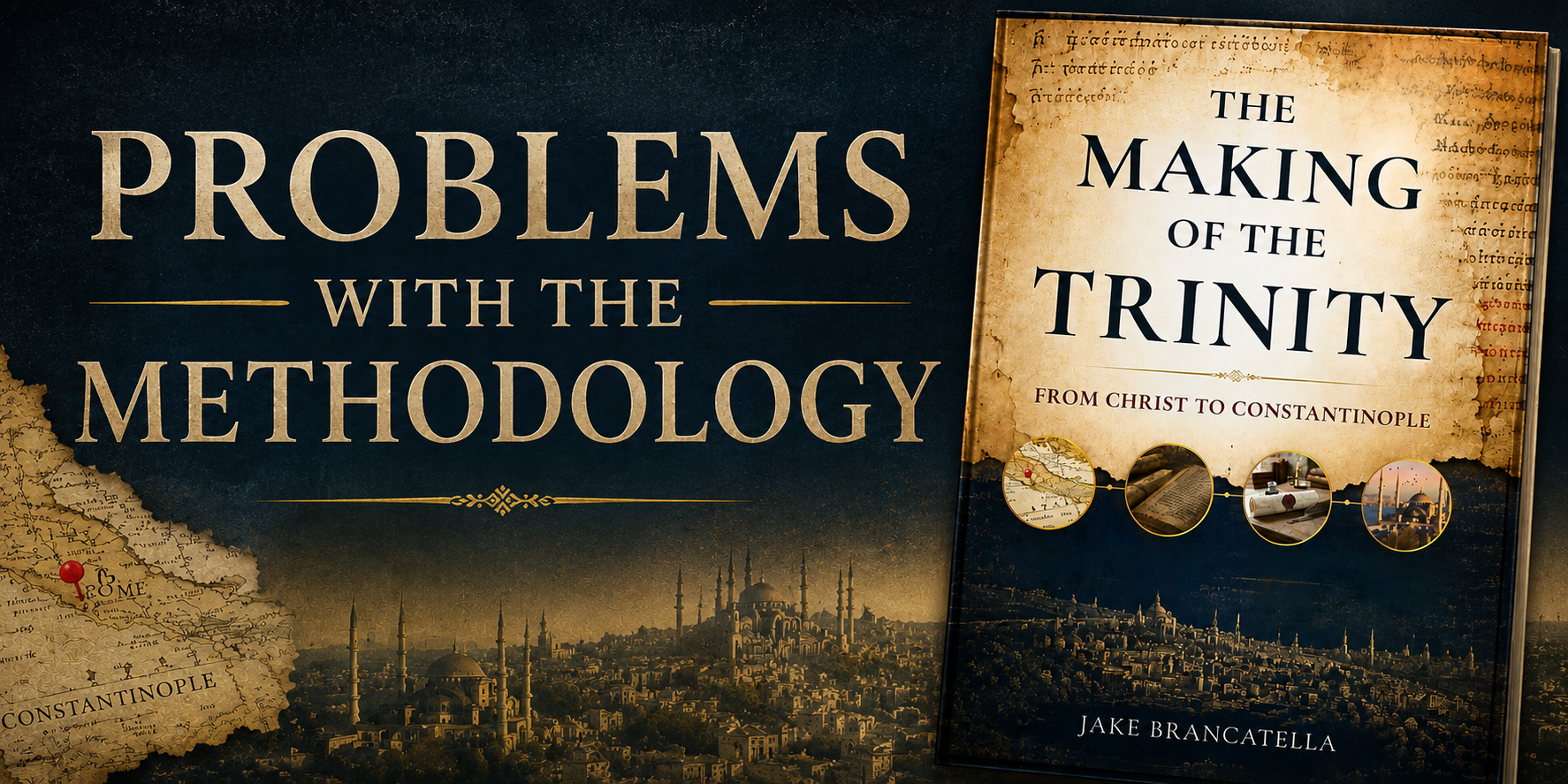
When I came across this book, I was quite excited (and still am), because as a Biblical Trinitarian, I welcome any sincere inquiry into one of the most cardinal doctrines of Christianity. So, while discussing this with some of my students in the Islamic courses I teach, three or four of us have decided to grapple together with the information we are discovering throughout this book.
Needless to say, this will be a slow read, but I am looking forward to seeing what we discover as we work through each section together. The first section we worked through deals with the methodology and scope of the book in the introduction, and we came to the following conclusions together:
I think there are several methodological problems with this approach, particularly if the goal is to determine whether the doctrine of the Trinity is probable, rather than merely to reconstruct how the doctrine developed historically.
First, the methodology seems to assume that the question can be settled primarily by examining how early Christians interpreted the New Testament. But this creates a potential authority shift. The original question is whether the Trinity is taught by Jesus and the apostles and whether it is a reasonable conclusion from the biblical evidence. Yet the proposed solution is to ask what the early Church Fathers thought about that biblical evidence. That can certainly be relevant, but the Church Fathers are not inspired interpreters. In other words, moving from “What does the New Testament teach?” to “What did Irenaeus, Tertullian, or Justin think the New Testament taught?” does not magically solve the exegetical problem. It merely gives us another set of interpreters to interpret.
Second, there is an interesting irony in claiming that examining the Church Fathers will “remove Islamic biases.” It may remove Islamic sources from the immediate discussion, but it does not remove bias from the investigation. The early Fathers had their own theological commitments, philosophical assumptions, ecclesial contexts, and controversies. They are valuable historical witnesses, but they are not neutral referees sitting in the theological equivalent of the VAR booth.
Third, the proposed scope may actually be too narrow in one sense and too broad in another. It is too narrow if the purpose is to establish whether Trinitarianism is probable, because restricting the investigation to the first three centuries of Christian literature leaves out important evidence from the biblical canon itself, the history of interpretation, textual criticism, Second Temple Jewish monotheism, and the development of early Christian Christology. At the same time, it is too broad if the intention is to survey “key figures” without first establishing clear criteria for which figures count as representative and why.
There is also a potential argument-from-antiquity problem lurking in the methodology. Suppose we discover that Justin Martyr, Irenaeus, Tertullian, Origen, and others held increasingly sophisticated views of the Father, Son, and Spirit. That would certainly demonstrate that Trinitarian concepts have very early roots. But antiquity by itself does not establish truth. An idea is not true because it is old, any more than it is false because it is old. If the Trinity is true, it should be possible to give reasons for believing it beyond simply saying, “Look, Christians were already saying interesting things about this in the second century.”
Fourth, the methodology seems to treat the debate as though there are only two possible options: proof-texting individual biblical passages or consulting the Church Fathers. That is a false dilemma. There are considerably better ways to evaluate a theological doctrine.
The Fifth Objection is what is called the Authority Shift and the “Sola Patristica” Trap. My first concern is that the proposed methodology seems to replace one problem with another. We are told that the goal is to determine whether the Trinity is a necessary or at least probable conclusion from biblical revelation and the teachings of Jesus. Fair enough. But then the methodology shifts the question from “What does Scripture teach?” to something closer to “What did Irenaeus, Tertullian, Justin Martyr, etc., think Scripture taught?” That is a significant shift in authority.
I have absolutely no problem with consulting the Church Fathers. In fact, I think they are enormously valuable historical witnesses. But they are witnesses, not inspired interpreters. They did not receive a second edition of the New Testament somewhere along the way. So, if the problem with proof-texting is that we can get bogged down arguing over things like θεὸς ἦν ὁ λόγος in John 1:1 and τὸν μόνον ἀληθινὸν θεόν in John 17:3, simply moving the argument to what Justin, Irenaeus, or Tertullian meant by hypostasis, ousia, prosōpon, or substantia does not actually make the problem disappear. We have simply moved the wrestling match into the second century. And now, instead of interpreting the biblical text, we have to interpret the interpreters of the biblical text. At some point we need to ask whether we have actually solved the exegetical problem or merely given it a toga.
Sixth, there seems to be the author’s illusion of neutrality. I know this might be a new logical fallacy, but we can see that the author is committing the VAR Booth Fallacy. Now this is interesting and quite a challenge even with postgraduate students who have to try and eliminate their own bias! This is obviously hard for all of us because we ALL have biases we need to contend with. So, here is the issue. The assumption that the author is bringing into the ante-Nicene Fathers somehow tries to give us a neutral playing field and, in particular, removes Islamic biases from the discussion. I am not done with a cursory reading of the book…but I am not convinced Jake is unbiased at all. He clearly has an axe to grind.
The Church Fathers were not sitting in some heavenly theological VAR booth with perfectly calibrated cameras, waiting to make an impartial ruling on the Trinity. They were theologians engaged in real controversies, with real theological commitments, philosophical assumptions, and ecclesiastical battles. They were fighting Gnosticism, Marcionism, Modalistic Monarchianism, and a host of other theological problems. Their writings therefore need to be understood within those contexts. Justin Martyr was not writing as a neutral referee. Neither was Tertullian. Neither was Origen…
And this creates another problem. If the methodology depends heavily upon achieving consensus about precisely what these writers meant, we have potentially exchanged one debate for another. We can now spend hours arguing about Justin’s Logos theology, Origen’s subordinationism, or exactly what a particular Father meant by a particular Greek term.
Which, admittedly, is wonderful news if you enjoy spending your evenings arguing about second-century metaphysics. But it does not necessarily establish that the methodology is neutral. It simply means that the historical investigation and author comes with its own interpretive baggage.
Seventh, pertaining to the scope of the author, there seems to be a clear imbalance. The problem is that the proposed scope seems to be both too narrow and too broad at the same time, which is quite an achievement (Well done Jake!).
It is too narrow because restricting the primary investigation to the first three centuries arbitrarily cuts off a significant portion of the evidence. For example, we cannot properly understand early Christian claims about the Father, Son, and Spirit without considering the Jewish monotheistic framework of the Second Temple period, the development of early Christian interpretation, and the eventual conciliar clarification of Trinitarian doctrine at Nicaea in AD 325 and Constantinople in AD 381.
If we stop the investigation at AD 300, we risk assuming that whatever appears earlier is automatically more authentic, while whatever becomes more precise later must therefore represent some kind of theological corruption. That would be a genetic fallacy. The fact that a doctrine becomes more precisely formulated later does not mean that the doctrine itself originated later. Sometimes later formulations exist precisely because earlier Christians were wrestling with questions that had not yet been forced into precise technical categories.
On the other hand, the methodology is also potentially too broad if we simply survey “key figures” without establishing objective criteria for deciding who actually counts as representative. Otherwise, we run straight into selection bias. Anti-Trinitarian arguments can very easily collect a handful of pre-Nicene statements containing subordinationist language and present them as though the entire early Church was essentially waiting for Arius to arrive. But that conveniently leaves some rather awkward witnesses sitting outside the room.
Ignatius of Antioch, for example, can refer to Jesus Christ as “our God” (ho theos hēmōn Iēsous Christos, Ephesians 18.2). Melito of Sardis likewise provides significant evidence of an early and remarkably high Christology. So we have to be careful about cherry-picking the Fathers who support our preferred reconstruction while quietly pretending the others have gone out for coffee. And finally, there is a basic methodological point here:
Antiquity does not equal truth.
The fact that second-century Christians were already wrestling with increasingly complex understandings of the Father, Son, and Spirit demonstrates that these ideas have very early historical roots. That is important evidence. But something does not become true merely because it is old. If that were the case, we would have to start taking ancient medical advice very seriously, and I think we can all agree that would end badly.
My last concern is that the methodology seems to establish a rather artificial either/or. We are presented with something like this:
Option A: Atomistic proof-texting and endless theological ping-pong.
Option B: Go to the ante-Nicene Fathers and see what the early Christians thought.
But why are these the only two options? Personally, I don’t think they are. A central Christian doctrine such as the Trinity requires an integrative and cumulative methodology (there…I said it!). We need to consider the biblical data in its literary and historical context, the Jewish monotheistic background, the teachings of Jesus, the Christological and pneumatological evidence of the New Testament, the development of early Christian interpretation, and the historical circumstances that eventually led to the conciliar formulations. Now I know in later chapters the author does make some claims about specific authors and ideas we need to consider. For the sake of this post’s length, I will refrain from commenting on those in the future.
In other words, we do not have to choose between “just give me John 1:1” and “let’s read every Father before Nicaea.” The better approach is to ask how all of the relevant evidence fits together. The question is not simply, “Can I find a verse that sounds Trinitarian?” Nor is it merely, “Can I find a second-century Christian who said something interesting about the Logos?”
The real question is whether the totality of the biblical evidence, understood within its historical and theological context, provides sufficient grounds for the Trinitarian conclusion—and then whether the subsequent development of Trinitarian doctrine represents a faithful clarification of that revelation or a departure from it. That, in my view, is a much more interesting question. And thankfully, it also means we don’t have to pretend that the Holy Spirit stopped working at AD 300 and left the Church with a theological cliffhanger.
Alternative Ways to Determine Whether the Trinity Is Probable
A stronger methodology would treat the doctrine as a cumulative case rather than attempting to locate one magical “Trinity verse.” Nobody needs to find a verse saying, “God is one essence existing eternally in three persons.” If that were the standard, Christians would have to start worrying about whether the Bible teaches the word Bible.
Instead, we can ask several interconnected questions.
1. What does Scripture teach about God?
Begin with the biblical commitment to monotheism. The question is not simply whether the Bible says “one God,” but what kind of monotheism it presents and whether the Father, Son, and Spirit can coherently be included within that confession without multiplying gods.
2. What does Scripture teach about the Father, Son, and Holy Spirit individually?
We can then examine whether each is presented merely as a creature, as a divine agent, or in ways that place them within the unique identity and activity of Israel’s God. For Christ, this would include passages concerning his divine identity, worship, authority, creation, pre-existence, forgiveness of sins, judgment, and relationship to the Father. For the Spirit, the question is whether the Spirit is merely an impersonal force or whether Scripture presents the Spirit as acting, speaking, knowing, willing, being sent, and relating personally to the Father and Son—and whether the Spirit is included in divine contexts.
3. How does Scripture distinguish the Father, Son, and Spirit?
This is crucial. A good Trinitarian argument cannot simply demonstrate that the Father, Son, and Spirit are divine. It must also demonstrate that they are distinguishable from one another. The Father sends the Son. The Son prays to the Father. The Spirit is sent by the Father and the Son. These relationships are difficult to explain if Father, Son, and Spirit are simply three names for the same person.
4. How does Scripture hold divine unity and personal distinction together?
This is where the cumulative case becomes interesting. The biblical data appear to pull in two directions:
- There is one God.
- The Father is God.
- The Son is presented as divine.
- The Spirit is presented as divine.
- The Father, Son, and Spirit are personally distinguishable.
The doctrine of the Trinity can then be evaluated as a theological model that attempts to account for all of these biblical claims simultaneously.
That is a much stronger methodology than looking for a single proof-text.
5. What did the earliest Christians believe?
This is where the Church Fathers become extremely important, but as historical evidence rather than the ultimate authority.
If Christians in the first and second centuries already worshipped Jesus, spoke of him in divine terms, distinguished him from the Father, and incorporated the Spirit into their theological and liturgical life, that significantly affects the historical plausibility of the claim that Nicene Trinitarianism was simply invented in the fourth century.
However, we should also expect development in terminology. There is nothing suspicious about the Church eventually developing technical vocabulary such as ousia and hypostasis in order to explain biblical convictions. The question is whether the later terminology represents a development of earlier beliefs or a theological innovation that fundamentally changes them.
6. What historical problem was Nicene theology actually trying to solve?
Rather than asking merely, “When was the Trinity invented?”, we should ask why the Church needed increasingly precise formulations. The fourth-century controversies did not arise in a vacuum. They were attempts to answer an existing problem: How can Christians maintain monotheism while confessing the Father as God, the Son as God, and yet refusing to collapse the Father and Son into one person? That makes the development of Trinitarian doctrine considerably more interesting than the simplistic “Jesus taught X, then Constantine invented Y” narrative.
7. Which model best explains the total evidence?
Finally, the question should become comparative. Does classical Trinitarianism explain the biblical and historical evidence better than:
- Unitarianism?
- Arianism?
- Modalism?
- Islamic tawḥīd?
- A generic “Jesus is divine but not God” model?
- Or some other theological model?
This is where inference to the best explanation becomes useful. We are not merely asking whether someone can find a verse that appears compatible with their theology. Almost every theological system can find a few verses that appear compatible with it. The real question is which model best accounts for all the relevant evidence with the fewest ad hoc qualifications.
The Fundamental Methodological Issue
Therefore, I would argue that the methodology should distinguish between three different questions:
- Historical: When and how did explicit Trinitarian terminology develop?
- Exegetical: What do the biblical texts actually teach about God, Jesus, and the Holy Spirit?
- Systematic/philosophical: Which theological model best explains the entire biblical and historical dataset?
These questions overlap, but they should not be collapsed into one another. The Church Fathers are therefore extremely useful, but they cannot function as the final court of appeal. If the Trinity is true, its probability should not depend upon whether a second-century Christian happened to formulate the doctrine with fourth-century precision. Conversely, if an early Christian failed to articulate the doctrine clearly, that would not by itself disprove it.
A more robust approach would therefore construct a cumulative case for the Trinity: biblical monotheism + the divine identity of Christ + the divine/personal identity of the Spirit + distinction between Father, Son, and Spirit + earliest Christian worship and belief + historical development + philosophical coherence. That would allow us to ask the much more interesting question: Does Trinitarianism provide the best explanation of the evidence available to us?
And that, in my view, is a much harder question to answer than simply counting how many second-century Christians used the right theological vocabulary.

Leave A Comment