

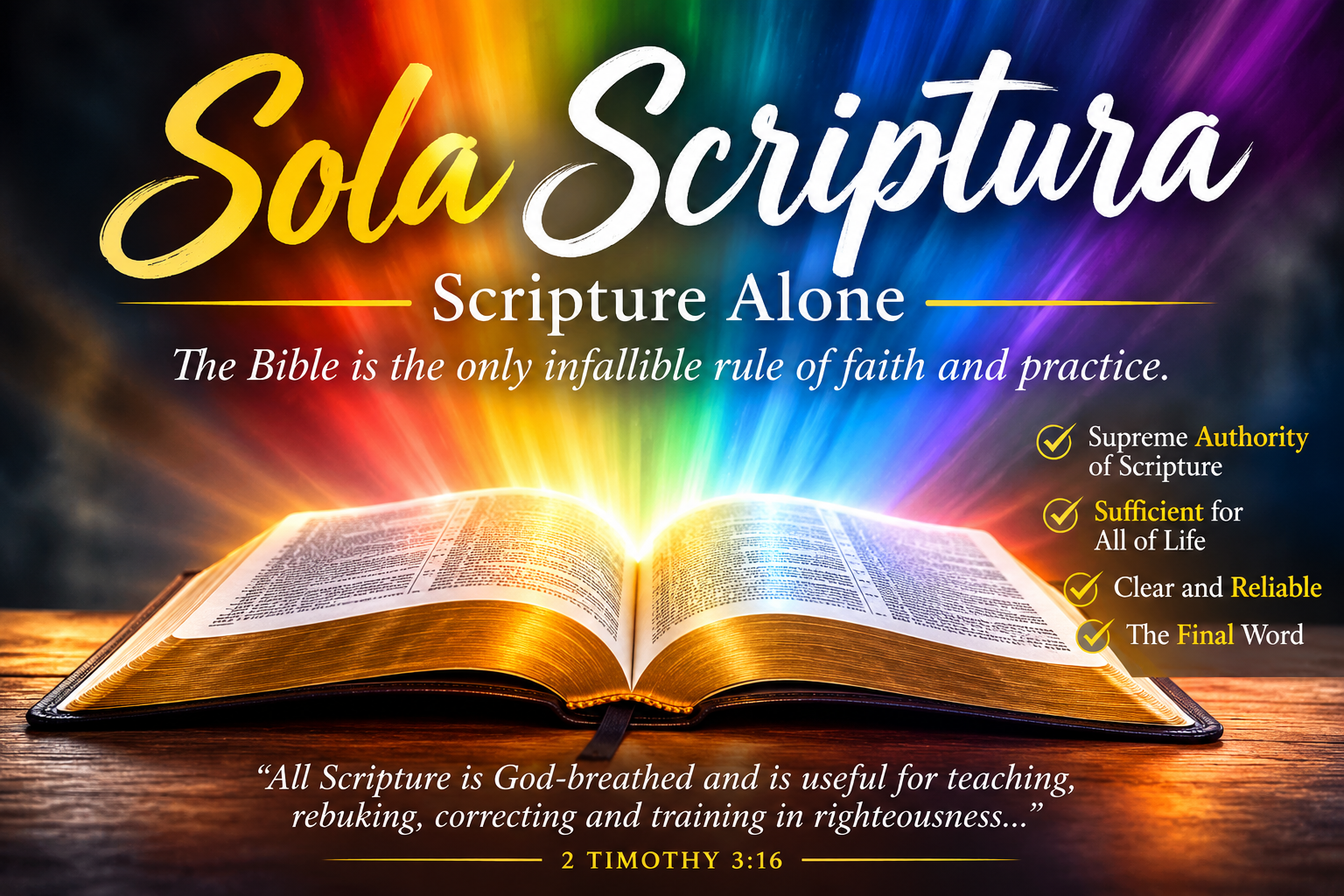
Every time a new piece of technology, medical procedure, or cultural trend pops up, a predictably tiresome pattern unfolds. Someone asks, “Is [insert modern phenomenon] sinful?” Someone else triumphantly snaps back, “Show me the chapter and verse!” When no specific verse containing the words algorithm, crypto, or TikTok appears, the conversation splits down the middle. On one side, you have the hyper-rationalists declaring that because the Bible doesn’t explicitly forbid it, God has zero opinion on it and we can’t make a moral judgment. On the other side, you have the over-zealous dogmatists inventing fresh, binding extra-biblical laws out of thin air, presenting their personal prudential preferences as the eleventh commandment: “Thou shalt not use filters.” Both sides suffer from the same fundamental error: a profound misunderstanding of Sola Scriptura. If you think Sola Scriptura means the Bible functions as a hyper-specific, line-item catalogue of every micro-decision you will ever make in the 21st century, you haven’t understood the Reformation. Worse yet, you’re missing out on the brilliant, liberating framework God actually gave us for living as free, wise human beings.
1. The Distinctions We Keep Ruining
Let’s clear the air on what the Reformers actually meant. As Wayne Grudem neatly summarizes in his Systematic Theology:
“By the sufficiency of Scripture, we mean that Scripture contains ‘all the words of God he intended his people to have at each stage of redemptive history.'” (p. 127)
Sola Scriptura does not mean Scripture is the only source of knowledge or guidance in existence. It means Scripture is the only infallible rule for faith and life. It is the supreme, ultimate norm by which every other claim, council, tradition, and personal opinion must be judged. The Westminster Confession of Faith (1.6) captures this with exquisite theological precision:
“The whole counsel of God concerning all things necessary for His own glory, man’s salvation, faith and life, is either expressly set down in Scripture, or by good and necessary consequence may be deduced from Scripture.”
Notice those two categories: expressly set down and deduced. The Bible isn’t just a list of “Do X” and “Don’t do Y.” It gives us a complete worldview and moral framework. God is Creator; humans bear His image; God is holy; we are called to love God and neighbour; the body belongs to God; wisdom is to be pursued; all things are for His glory. Because we have this revealed framework, we don’t need a new divine revelation every time Apple releases a software update.
-
The Bible doesn’t mention social media. But it gives us explicit commands regarding speech, gossip, envy, truthfulness, stewardship of time, and self-control.
-
The Bible doesn’t mention cars. But it commands us not to murder or endanger human life recklessly. We don’t need a verse reading “Thou shalt not drive 160 km/h through a school zone” to know that doing so violates the sixth commandment and the law of love.
The movement is simple: From Explicit Command to Biblical Principle then Wisdom which informs Application. The application may be brand new, but its normative foundation is as old as Genesis.
2. A 3-Zone Ethic: Sin, Liberty, and Wisdom
When we abandon this framework, we inevitably fall off the horse on either side. On one end stands rationalism, which falsely assumes that if a matter lacks an explicit chapter and verse, Christians are rendered completely incapable of making any moral assessment whatsoever. On the opposite end stands extra-biblical dogmatism, where a believer elevates their personal prudential judgment to the level of divine decree, binding the consciences of others where God has left them free. To navigate modern life without inventing a counterfeit legalism or sliding into moral lawlessness, we must distinguish between three distinct ethical categories: that which is sinful, that which is permissible, and that which is wise.
The category of the sinful encompasses everything that directly violates what Scripture expressly forbids or contradicts a clear, revealed principle. For example, watching pornography violates Matthew 5:28 and 1 Thessalonians 4:3–5. The fact that the internet did not exist when those texts were penned does not render them inapplicable; the moral violation remains unchanged. The category of the permissible addresses areas of Christian liberty, as outlined so brilliantly by Paul in Romans 14. Where Scripture has left a matter open and does not bind the conscience, we are forbidden from manufacturing arbitrary divine prohibitions. If God has not explicitly or implicitly forbidden an activity, we cannot declare it inherently sinful.
However, the Christian life does not end at mere permissibility, which brings us to the massive and often neglected category of wisdom. Paul famously writes in 1 Corinthians 10:23, “‘All things are lawful for me,’ but not all things are helpful. ‘All things are lawful for me,’ but not all things build up.” Something can be entirely permissible under Christian liberty without being remotely wise for your spiritual health, your family, or your walk with God. This is precisely why Sola Scriptura requires a robust doctrine of wisdom. Because Scripture does not micromanage every minute detail of 21st-century life, it demands that we mature into faithful readers of the Word who can reason rigorously, exercise sanctified prudence, and apply timeless divine principles to dynamic modern situations.
3. The Practical Decision-Making Grid
When you face a modern ethical issue or decision where no explicit “chapter and verse” exists, run it through this biblically grounded diagnostic grid:
| Question | Core Biblical Concern | Scripture Reference |
| 1. Is it explicitly forbidden? | Direct obedience to God’s commands | Exodus 20; Matthew 5 |
| 2. Is there a clear principle that applies? | Fidelity to God’s revealed Word | 2 Timothy 3:16–17 |
| 3. Does it reflect God’s character? | Holiness, justice, truth, and love | 1 Peter 1:15–16 |
| 4. Does it genuinely love my neighbour? | The Second Great Commandment | Matthew 22:39 |
| 5. What kind of person is this making me? | Sanctification and the Fruit of the Spirit | Galatians 5:22–23 |
| 6. Can I do it to the glory of God? | Ultimate purpose of human life | 1 Corinthians 10:31 |
| 7. Can I do it with a clear conscience? | Acting from faith | Romans 14:23 |
| 8. Will it master or enslave me? | Christian freedom vs. addiction/idolatry | 1 Corinthians 6:12 |
| 9. Will it build others up or stumble them? | Selfless love in community | 1 Corinthians 10:23–24 |
| 10. Is it actually wise? | Pursuing biblical prudence | Proverbs 4:7 |
| 11. What do mature believers advise? | Communal discernment | Proverbs 11:14 |
4. How to Defend Sola Scriptura Without Getting Trapped
If you are discussing this with Roman Catholic, Eastern Orthodox, or skeptical friends, don’t start by throwing around the Latin phrase Sola Scriptura. That usually leads to immediate circular arguments about church history. Instead, frame the discussion around epistemology—how we know what God has revealed, and what possesses the ultimate right to correct us.
Step 1: Establish Common Ground
Ask: “Do you believe God has given us authoritative, infallible revelation?” They will say yes. Then ask: “When competing traditions, teachers, or interpretations arise, what is the ultimate, infallible norm by which those claims are judged?”
Step 2: Clear up the “Me and My Bible” Myth
Clarify that Sola Scriptura is not “solo Scriptura.” The Reformers did not discard church history, creeds, councils, pastors, or tradition. Those entities possess real, ministerial authority. But their authority is derivative and subordinate. They can err, and therefore they must be tested by Scripture. Look at the Bereans in Acts 17:11:
“Now these Jews were more noble than those in Thessalonica; they received the word with all eagerness, examining the Scriptures daily to see if these things were so.”
Even the Apostle Paul’s teaching was tested against the written revelation of God!
Step 3: Ask the Crucial Epistemological Question
If your friend claims that the Church or Tradition provides the binding interpretation when Scripture is silent, ask: “How do we know that specific institution’s interpretation is infallible?” If they cite Scripture to prove the Church’s authority, they have acknowledged that Scripture is the higher authority validating the Church! If they cite Tradition to prove Tradition, they are in a circular loop.
Step 4: Distinguish Revelation, Interpretation, and Application
Make sure to separate these three distinct concepts:
-
Revelation: What God has flawlessly revealed (Infallible).
-
Interpretation: What we understand that revelation to mean (Fallible, checked by Scripture).
-
Application: How we apply that truth to a modern circumstance (Requires wisdom).
Sola Scriptura asserts that Scripture is the supreme ruler over all three. It doesn't mean your personal application is an infallible divine decree; it means your application must answer to God's Word.
The Bottom Line
Where Scripture gives a clear command, we obey it. Where Scripture gives principles, we apply them. Where Scripture gives freedom, we exercise wisdom and love. And in everything, we seek the glory of God. The next time someone tries to bind your conscience with a rule not found in Scripture, or conversely, claims that total lawlessness is fine because “the Bible doesn’t explicitly mention it,” remember the beauty of the Reformed position. God didn’t leave us an exhaustive, rigid legal code for every gadget and culture shift. He gave us His sufficient Word, His Holy Spirit, and the freedom to grow up into wise, discerning sons and daughters.


Leave A Comment