


There is no dispute that the Qur’an treats Late Antique Syriac and Rabbinic folklore as canonical history. Let’s face it, if one is attempting to demonstrate a uniquely unmediated divine dictation, leaning heavily on the Life of Adam and Eve—a text that was essentially the theological fan-fiction of Late Antiquity—is a rather precarious position to take.
The Late Antique Milieu of the Qur’anic Adam and Eve
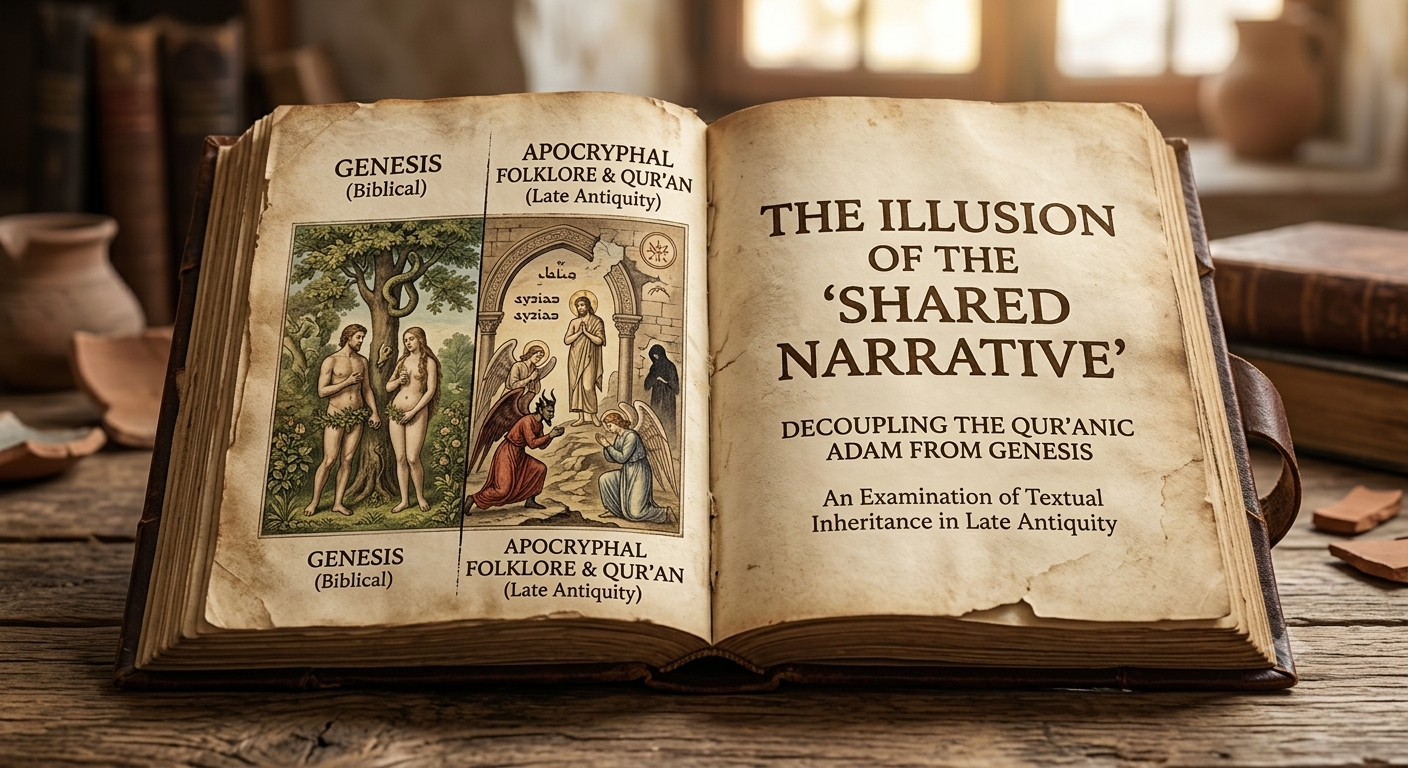
The Qur’an contains a repetitive but highly theological account of Adam and Eve. While Islamic tradition—especially tafsīr (exegesis) and the Qiṣaṣ al-Anbiyāʾ (Stories of the Prophets)—expands these narratives considerably, the Qur’an itself demonstrates profound literary and thematic parallels with earlier Jewish and Christian apocryphal literature.
Critically, this overlap does more than just show a “shared environment.” It actively demonstrates that the Qur’an’s author(s) drew upon the prevailing Syriac Christian and Rabbinic Jewish folklore of the era, presenting these post-biblical apocryphal expansions as historical, canonical fact. By examining the precise literary parallels, the argument for the Qur’an as a product of its Late Antique sectarian milieu is significantly strengthened, refuting the classical Islamic paradigm of historical isolation.
Below are the clearest parallels, complete with exact source citations and linguistic markers.
1. The Command to Prostrate and Satan’s Refusal
The Parallel: Genesis contains no account of angels being commanded to bow to Adam, nor Satan’s refusal. This motif is entirely post-biblical, yet it forms the central drama of the Qur’anic creation narrative.
-
Apocryphal Tradition: In the Latin Vita Adae et Evae (Life of Adam and Eve, 13:1–15:3) and the Syriac Cave of Treasures (2:12–24), God creates Adam, commands the angels to worship the image of God, and Satan explicitly refuses. In Vita 14:3, Satan declares: “I will not worship one inferior and younger than I.”
-
Qur’anic Account: The Qur’an repeats this exact sequence across several chapters. “And when We said to the angels, ‘Prostrate yourselves before Adam’ (us’judū li’ādama / اسْجُدُوا لِآدَمَ), they all prostrated except Iblis…” This appears in Surah Al-Baqarah (2:34), Al-A’raf (7:11), Al-Hijr (15:28–31), Al-Isra (17:61), Al-Kahf (18:50), Ta-Ha (20:116), and Sad (38:73).
2. Satan’s Ontological Envy
The Parallel: Why does Satan refuse? Both traditions explain it through a sudden bout of ontological snobbery regarding Adam’s material composition.
-
Apocryphal Tradition: The Cave of Treasures explicitly records Satan’s disgust at Adam being formed from dust, while the Vita Adae et Evae (16:1-3) explains that Satan hated Adam because God exalted this material creation above the angels.
-
Qur’anic Account: In Surah Al-A’raf (7:12) and Surah Sad (38:76), Iblis justifies his rebellion using the exact same logic: “I am better than him. You created me from fire and created him from clay” (khalaqtanī min nār wa-khalaqtahu min ṭīn / خَلَقْتَنِي مِن نَّارٍ وَخَلَقْتَهُ مِن طِينٍ).
3. The Extended Repentance of Adam
The Parallel: The canonical Genesis account ends with expulsion and silence. Both the apocrypha and the Qur’an, however, emphasize Adam’s immediate, formal repentance.
-
Apocryphal Tradition: In the Vita Adae et Evae (6:1–8:3), Adam and Eve perform extended, liturgical acts of penance. Adam stands in the Jordan River for forty days, fasting and praying for forgiveness.
-
Qur’anic Account: Surah Al-Baqarah (2:37) encapsulates this post-biblical tradition of Adam’s successful penance: “Then Adam received words from his Lord, and He accepted his repentance.”
4. Satan’s Continued Campaign and Demonic Respite
The Parallel: In Genesis, the serpent is cursed and the narrative moves on. In the Late Antique imagination, Satan bargains for time and promises a perpetual guerrilla war against humanity.
-
Apocryphal Tradition: The Ethiopic Conflict of Adam and Eve with Satan (Book I, Ch. 11–15) portrays Satan repeatedly attempting to deceive and destroy Adam after Eden. Furthermore, in Jubilees (10:7–11), the chief demon Mastema successfully petitions God to let a percentage of evil spirits remain active to test humanity.
-
Qur’anic Account: The Qur’an mirrors both the petition and the vow. In Surah Al-A’raf (7:14), Iblis asks, “Grant me respite until the Day they are resurrected” (anẓirnī ilā yawmi yub’athūn / أَنظِرْنِي إِلَى يَوْمِ يُبْعَثُونَ). God grants this, prompting Iblis to vow: “I will surely sit in wait for them on Your straight path” (Surah Al-A’raf 7:16).
5. Creation from Mud and Clay
The Parallel: While Genesis 2:7 mentions dust (‘afar min ha-‘adamah), later literature obsesses over the visceral wetness of the clay.
-
Apocryphal Tradition: The Book of Jubilees (3:32) and the Cave of Treasures elaborate heavily on Adam being molded from specific earth and water mixtures.
-
Qur’anic Account: The Qur’an emphasizes the wet, sounding clay repeatedly: Surah Al-Hijr (15:26) states he was made “from sounding clay of altered black mud” (min ṣalṣālin min ḥama’in masnūn / مِّن صَلْصَالٍ مِّنْ حَمَإٍ مَّسْنُونٍ). See also Surah Al-Mu’minun (23:12) and Surah As-Sajdah (32:7).
6. The Deception of Eve
The Parallel: Genesis famously points the finger at the serpent. Later traditions bypass the reptile and point directly to the spiritual entity behind it.
-
Apocryphal Tradition: The Greek Apocalypse of Moses (16:1–19:3) explicitly attributes the deception of Eve directly to Satan, who uses the serpent merely as a vehicle.
-
Qur’anic Account: The Qur’an bypasses the serpent entirely—an animal entirely absent from the Islamic Eden. In Surah Ta-Ha (20:120), the tempter is explicitly and exclusively named: “Then Satan whispered to him…” (fawaswasa ilayhi al-shayṭān / فَوَسْوَسَ إِلَيْهِ الشَّيْطَانُ).
A Major Theological Divergence
While the Qur’an borrows the narrative scaffolding of the apocrypha, it radically alters the theological payload regarding inherited guilt.
The Christian apocryphal literature often portrays Adam’s sin as catastrophic, infecting humanity and anticipating the Pauline theology of peccatum originale (original sin) expressed in Romans 5. The Qur’an, however, strips the narrative of its soteriological weight. In the Islamic paradigm: Adam sinned, Adam repented, God forgave him, and the ledger was wiped clean. The Qur’an dogmatically insists that “no bearer of burdens will bear the burden of another” (waziratun wiz’ra ukhrā / وَازِرَةٌ وِزْرَ أُخْرَى), a principle stated in Surah Al-An’am (6:164) and Surah An-Najm (53:38).
Ultimately, this demonstrates that the Qur’an is actively curating Late Antique traditions: importing the popular Syriac narratives that resonate with its worldview, while deliberately excising the Christian redemptive theology embedded within them.
References
Anderson, G.A. and Stone, M.E. (eds.), 2000. A Synopsis of the Books of Adam and Eve. 2nd ed. Atlanta: Scholars Press.
(Essential for tracking the exact verses in the Latin Vita and Greek Apocalypse of Moses).
Griffith, S.H., 2013. The Bible in Arabic: The Scriptures of the “People of the Book” in the Language of Islam. Princeton: Princeton University Press.
(Details how biblical and extra-biblical lore circulated in the oral, Syriac-speaking environments of pre-Islamic Arabia).
Minov, S., 2020. Memory and Identity in the Syriac Cave of Treasures. Leiden: Brill.
(Crucial for the Syriac connections regarding Satan’s refusal to bow to Adam’s clay form).
Neuwirth, A., 2019. The Qur’an and Late Antiquity: A Shared Heritage. Oxford: Oxford University Press.
(Provides the academic framework for understanding the Qur’an as a participant in Late Antique theological debates rather than an isolated text).
Reynolds, G.S., 2010. The Qur’an and its Biblical Subtext. London: Routledge.




Leave A Comment