

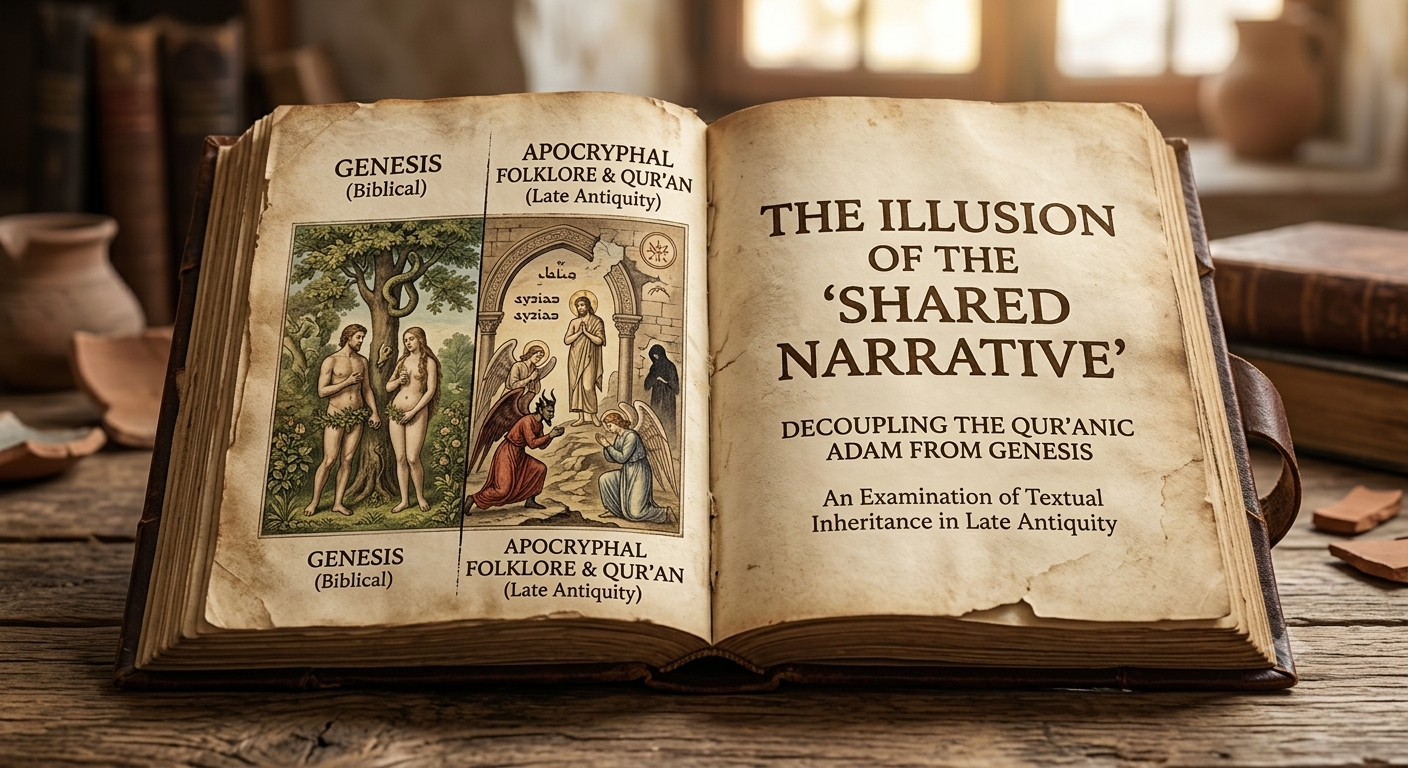
In contemporary interfaith dialogue, a popular strategy for building common ground is to point to what appears to be a unified scriptural heritage. A prime example of this can be found in Dr. Osman Latif’s book, Divine Perfection: Christianity and Islam on Sin and Salvation.
During discussions of the text—specifically the timestamp range 2:39–4:23—a foundational claim is made to establish a theological bridge between the two faiths under the banner of a “shared narrative”. However, a closer historical, theological, and philological examination reveals that this shared narrative is an illusion that glosses over the historical reality of text transmission in Late Antiquity.
1. The Claim: A Unified Creation Account
The Speaker’s Claim: “Dr Latiff attempts to build common ground by stating that Christianity and Islam share the same basic narrative of Adam from Genesis and the Qur’an: created from earth, placed in a garden, commanded not to eat from a tree, and tempted by Satan.”
At first glance, these surface-level similarities seem striking. Both traditions account for a primeval man formed from the dust of the ground, an idyllic garden setting, a divine prohibition regarding a tree, and an adversarial tempter. But as the historical data demonstrates, not all similarities are direct parallels! To assume that these shared motifs imply a shared source or a unified theological trajectory is to fundamentally misunderstand the textual landscape of the ancient Near East.
2. The Refutation: Peeling Back the Layers of Late Antiquity
The Refutation: “This claim completely glosses over the historical reality of where the Qur’an actually gets its narrative. The structural details the Qur’an includes do not come from Genesis; they come from post-biblical, highly embellished sectarian folklore circulating in Late Antiquity.”
The fundamental issue with Dr. Latif’s claim is that it completely overlooks where the Qur’an actually derives its narrative structure. The specific, unique structural details included in the Qur’an do not come from the canonical Hebrew text of Genesis; rather, they align directly with post-biblical, highly embellished sectarian folklore circulating throughout the Near East in Late Antiquity.
“The Qur’an contains a repetitive but highly theological account of Adam and Eve. While Islamic tradition—especially tafsīr (exegesis) and the Qiṣaṣ al-Anbiyāʾ (Stories of the Prophets)—expands these narratives considerably, the Qur’an itself demonstrates profound literary and thematic parallels with earlier Jewish and Christian apocryphal literature.”
Critically, this overlap does more than just show a vaguely defined “shared environment”. It actively demonstrates that the Qur’an’s author(s) drew upon the prevailing Syriac Christian and Rabbinic Jewish folklore of the era, presenting these post-biblical apocryphal expansions as historical, canonical fact. By examining the precise literary parallels, the argument for the Qur’an as a product of its Late Antique sectarian milieu is significantly strengthened, refuting the classical Islamic paradigm of historical isolation.
Let us examine six distinct instances in the story of Adam that expose this direct literary dependence:
Parallel I: The Command to Prostrate and Satan’s Refusal
The canonical text of Genesis contains absolutely no account of angels being commanded to bow to Adam, nor does it contain Satan’s refusal. This motif is entirely post-biblical, yet it forms the central drama of the Qur’an’s creation narrative.
-
The Apocryphal Tradition: In the Latin Vita Adae et Evae (Life of Adam and Eve, 13:1–15:3) and the Syriac Cave of Treasures (2:12–24), God creates Adam, commands the angels to worship the image of God, and Satan explicitly refuses. In Vita 14:3, Satan declares: “I will not worship one inferior and younger than I.”
-
The Qur’an Account: The Qur’an repeats this exact sequence across several chapters.
“And when We said to the angels, ‘Prostrate yourselves before Adam’ (us’judū li’ādama), they all prostrated except Iblis…”
This exact narrative arc appears repetitively in Surah Al-Baqarah (2:34), Al-A’raf (7:11), Al-Hijr (15:28–31), Al-Isra (17:61), Al-Kahf (18:50), Ta-Ha (20:116), and Sad (38:73).
As Islamic studies scholar Gabriel Said Reynolds notes:
“The Qur’an’s account of Iblis’s refusal to prostrate before Adam is a striking instantiation of its reliance on homiletic and apocryphal traditions active in the Near East. This narrative arc—absent from canonical biblical texts—closely tracks the account found in the Life of Adam and Eve and the Syriac Cave of Treasures, demonstrating that the Qur’an adopts the narrative architecture of Late Antique sectarian homilies as historical history.” — Gabriel Said Reynolds, The Qur’an and Its Biblical Subtext (2010), p. 43
Parallel II: Satan’s Ontological Envy
In the biblical context, Satan’s rebellion is understood as an act of pride against God, wanting to take the Almighty’s place. However, in the Qur’anic story, the devil objects specifically to Adam’s ontology. Why does Satan refuse? Both the apocrypha and the Qur’an explain it through a sudden bout of ontological snobbery regarding Adam’s material composition.
-
The Apocryphal Tradition: The Cave of Treasures explicitly records Satan’s disgust at Adam being formed from dust, while the Vita Adae et Evae (16:1–3) explains that Satan hated Adam because God exalted this material creation above the angels.
-
The Qur’an Account: In Surah Al-A’raf (7:12) and Surah Sad (38:76), Iblis justifies his rebellion using the exact same logic:
“I am better than him. You created me from fire and created him from clay” (khalaqtanī min nār wa-khalaqtahu min ṭīn / خَلَقْتَنِي مِن نَّارٍ وَخَلَقْتَهُ مِن طِينٍ).
Scholar Sergey Minov explains the exact path of this transmission:
“The motif of Satan’s refusal to worship Adam because of the latter’s inferior, terrestrial composition becomes a standard element of Syriac Christian lore. In these texts, Satan’s pride is provoked precisely by the wet clay or dust of Adam’s body, a physical detail that the Qur’an elevates to a central, repetitive theological rationale for the cosmic fall of Iblis.” — Sergey Minov, Memory and Identity in the Syriac Cave of Treasures (2020), p. 124
Parallel III: The Extended Repentance of Adam
The canonical Genesis account ends with expulsion, divine judgment, and narrative silence regarding any formal spoken ritual of penance. Both the apocrypha and the Qur’an, however, emphasize Adam’s immediate, formal, and spoken repentance.
-
The Apocryphal Tradition: In the Vita Adae et Evae (6:1–8:3), Adam and Eve perform extended, liturgical acts of penance. Adam stands in the Jordan River for forty days, fasting and praying for forgiveness.
-
The Qur’an Account: Surah Al-Baqarah (2:37) encapsulates this exact post-biblical tradition of Adam’s successful, spoken penance:
“Then Adam received words from his Lord, and He accepted his repentance.”
Scholars have long recognized that this matches the evolution of the primary Adam literature:
“The extra-biblical expansion wherein Adam is provided specific formulas or rituals for repentance finds its clearest historical anchor in the primary Adam literature. The Qur’an’s reference to Adam ‘receiving words’ from his Lord to achieve restoration mirrors the textual traditions of the Synopsis, where Adam’s vocalized lamentations and liturgical compliance reverse the immediate consequence of his fall.” — Gary A. Anderson and Michael E. Stone, A Synopsis of the Books of Adam and Eve (2000), p. 22g
Parallel IV: Satan’s Continued Campaign and Demonic Respite
In Genesis, the serpent is cursed, and the narrative moves forward into human history. In the Late Antique imagination, however, Satan bargains with God for time and promises a perpetual guerrilla war against humanity.
-
The Apocryphal Tradition: The Ethiopic Conflict of Adam and Eve with Satan (Book I, Ch. 11–15) portrays Satan repeatedly attempting to deceive and destroy Adam after Eden. Furthermore, in the Book of Jubilees (10:7–11), the chief demon, Mastema, successfully petitions God to allow a percentage of evil spirits to remain active to test humanity.
-
The Qur’an Account: The Qur’an mirrors both this formal petition and the subsequent vow. In Surah Al-A’raf (7:14), Iblis asks:
“Grant me respite until the Day they are resurrected” (anẓirnī ilā yawmi yub’athūn / أَنظِرْنِي إِلَى يَوْمِ يُبْعَثُونَ).
God grants this request, prompting Iblis to vow:
“I will surely sit in wait for them on Your straight path” (Surah Al-A’raf 7:16).
As Gabriel Said Reynolds details:
“The dialogue in which Satan secures an extension of time or ‘respite’ from God to harass mankind is a direct continuation of the demonology developed in the Book of Jubilees. The Qur’an incorporates this structural allowance, framing Satan not merely as a localized tempter in a garden, but as an apocalyptic antagonist whose operational timeframe is extended by divine decree.” — Gabriel Said Reynolds, The Qur’an and Its Biblical Subtext (2010), p. 51
Parallel V: Creation from Mud and Clay
While Genesis 2:7 mentions dust (‘afar min ha-‘adamah), later non-canonical literature obsesses over the visceral, wet chemistry of the clay.
-
The Apocryphal Tradition: The Book of Jubilees (3:32) and the Cave of Treasures elaborate heavily on Adam being molded from specific earth and water mixtures.
-
The Qur’an Account: The Qur’an emphasizes this wet, sounding clay repeatedly. Surah Al-Hijr (15:26) states he was made “from sounding clay of altered black mud” (min ṣalṣālin min ḥama’in masnūn / مِّن صَلْصَالٍ مِّنْ حَمَإٍ مَّسْنُونٍ). This physical emphasis is repeated in Surah Al-Mu’minun (23:12) and Surah As-Sajdah (32:7).
Late Antique expert Angelika Neuwirth maps this directly to regional Christian poetry:
“The Qur’an’s insistence on the physical properties of the material used to fashion Adam—such as sticky clay or dark, molded mud—is an echo of the intense material speculation characteristic of Late Antique Christian poetry, notably that of Ephrem the Syrian and Narsai, who focused on the visceral chemistry of human creation to counter gnostic dualism.” — Angelika Neuwirth, The Qur’an and Late Antiquity: A Shared Heritage (2019), p. 231
Parallel VI: The Deception of Eve
The Genesis text famously highlights the physical serpent as the immediate deceptive agent. Later traditions, however, bypass the reptile and point directly to the spiritual entity operating behind it.
-
The Apocryphal Tradition: The Greek Apocalypse of Moses (16:1–19:3) explicitly attributes the deception of Eve directly to Satan, who uses the serpent merely as a passive vehicle.
-
The Qur’an Account: The Qur’an bypasses the animal agent entirely—the serpent is completely absent from the Islamic Eden. In Surah Ta-Ha (20:120), the tempter is explicitly and exclusively named:
“Then Satan whispered to him…” (fawaswasa ilayhi al-shayṭān / فَوَسْوَسَ إِلَيْهِ الشَّيْطَانُ).
Sidney H. Griffith explains this text-historical evolution:
“By the sixth and seventh centuries, Christian and Jewish oral cultures in Arabia had largely psychologized or spiritualized the Eden narrative, looking past the literal serpent of Genesis to focus on the devil himself. The Qur’an reflects this exact stage of text-historical evolution, systematically omitting the animal agent and attributing the ‘whispering’ directly to Al-Shaytan.” — Sidney H. Griffith, The Bible in Arabic: The Scriptures of the ‘People of the Book’ in the Language of Islam (2013), p. 162
3. The Academic and Apologetic Critique
The systematic inclusion of these extra-biblical, pseudepigraphical, and folkloric narratives presents profound historical, theological, and logical challenges to the Qur’an’s self-attested status as an unmediated, divinely dictated revelation. This dependency shatters the paradigm of a “shared narrative” on four fronts:
A. The Methodological Anachronism (The Timeline Problem)
The foundational claim of classical Islam is that the Qur’an is an unmediated dictation from eternity (Lawḥ Maḥfūẓ), completely isolated from human literary production. However, historical-critical analysis demonstrates that the Qur’an incorporates narrative details that did not exist during the lifetimes of the biblical figures it describes.
The theological expansions of the Vita Adae et Evae or the Syriac Cave of Treasures developed centuries after the closure of both the Hebrew and Christian canons to address specific internal theological debates or homiletic needs of Late Antique communities. If these details were part of original, uncorrupted history, we would have to assume that God withheld historical details from Moses, gave them exclusively to speculative, uncanonical second-to-sixth-century sectarian human writers, and then canonized those human embellishments in the seventh century as pure history.
B. Mistaking Human Exegesis for Canonical Event
The Qur’an frequently treats the creative commentary, homilies, and pedagogical tools of Jewish rabbis and Syriac monks as raw historical fact; it essentially treats the midrash (exegesis) as the text. In the ancient Near East, teachers used imaginative expansions to teach theological truths (such as staging a dialogue where Satan refuses to bow to Adam’s clay form). These were explicitly understood by their original audiences as homiletic illustrations—not canonical history. By absorbing these late homiletic devices directly into its accounts, the author of the Qur’an demonstrates an inability to distinguish between the Bible’s actual text and local, contemporary oral folklore circulating in the 7th-century Hijaz.
C. The Collapse of the “Tahrif” (Corruption) Argument
When confronted with differences between the Bible and the Qur’an, Islamic apologists traditionally appeal to the doctrine of taḥrīf—claiming that Jews and Christians altered or lost their original scriptures (Torah and Injeel). The inclusion of apocryphal material entirely undermines this defense. If the Bible were simply “corrupted,” a restorative divine revelation would logically correct the text back to its pristine, original historical state. Instead, the Qur’an bypasses the older, canonical biblical accounts and aligns itself precisely with the highly embellished, localized innovations of Late Antiquity. The Qur’an does not restore a lost, ancient original; it canonizes a late, human evolution.
D. The Linguistic and Cultural Custody Trail
The precise literary links do not point to a cosmic, heavenly origin, but to a horizontal, geographic transmission. The vocabulary and specific motifs found in the Qur’an mirror the exact polemical concerns of the Syriac-speaking churches (Melkite, Jacobite, and Nestorian) and Rabbinic academies operating near the Arabian Peninsula prior to Islam.
As Sidney H. Griffith notes:
“The text-historical reality is that the Qur’an reflects a specific stage of religious evolution where biblical texts had already been processed through centuries of oral translation, preaching, and midrashic expansion. The author writes from within this cultural custody trail, treating the local, contemporary state of the narrative as the eternal standard.” — Sidney H. Griffith, The Bible in Arabic (2013), p. 162
For the Islamic paradigm of I’jaz (the inimitable, divine origin of the text), this is a fatal vulnerability. If an author claims to be receiving a direct transmission from the Creator of history, but that transmission matches—word for word, motif for motif—the localized, historically traceable mistakes and creative fictionalizations of human writers living just a few generations prior, the most logical, historically sustainable conclusion is literary dependence. The author of the Qur’an was a brilliant curator of his environment, but he was fundamentally limited by the oral, apocryphal, and sectarian library available to him in 7th-century Arabia.
4. De-contextualizing the Theological Payload
While the Qur’an borrows the narrative scaffolding of the apocrypha, it radically alters the theological payload regarding inherited guilt. The Christian apocryphal literature often portrays Adam’s sin as catastrophic, infecting humanity and anticipating the Pauline theology of peccatum originale (original sin) expressed in Romans 5.
The Qur’an, however, strips the narrative of its soteriological weight. In the Islamic paradigm: Adam sinned, Adam repented, God forgave him, and the ledger was wiped clean. The Qur’an dogmatically insists that “no bearer of burdens will bear the burden of another” (waziratun wiz’ra ukhrā / وَازِرَةٌ وِزْرَ أُخْرَى), a principle stated in Surah Al-An’am (6:164) and Surah An-Najm (53:38).
Ultimately, this demonstrates that the Qur’an is actively curating Late Antique traditions: importing the popular Syriac narratives that resonate with its worldview, while deliberately excising the Christian redemptive theology embedded within them.
“The Qur’an engages in a sophisticated process of critical selection and theological de-contextualization. It eagerly integrates the vibrant narrative imagery of Syriac Christian lore while explicitly rejecting the theological consequences—namely, the doctrines of original sin, inherited guilt, and the consequent necessity of a divine Redeemer.” — Angelika Neuwirth, The Qur’an and Late Antiquity: A Shared Heritage (2019), p. 245
5. Dismantling the Speaker’s Strawmen
To keep this “shared narrative” alive, Islamic polemics often resort to misrepresenting the Christian position to make the Islamic alternative look more appealing. Dr. Latif’s presentation relies on two massive distortions:
The “Damned Adam” Strawman
The speaker claims that in the biblical narrative, Adam is simply “condemned,” has “no more relevance in the cosmos of human salvation,” and is effectively forgotten. He explicitly cites a Christian theologian, “Dr. Louganbill” (Dr. Robert Luginbill), claiming he teaches that Adam suffered three types of damnation (physical, spiritual, eternal) and is “just out, he’s finished.”
The Refutation: This is a massive, easily debunked academic misrepresentation of both historic Christian theology and the very source the speaker cites.
-
Misrepresenting the Source: Dr. Robert Luginbill does not teach that Adam is eternally damned. In his systematic theology (Angelology: The Study of Angels and Hamartiology), Luginbill explicitly argues that Adam and Eve were saved. He teaches that God’s provision of animal skins in Genesis 3:21 was the first archetype of substitutionary atonement, cloaking their physical and spiritual nakedness with the righteousness of God. Adam isn’t “out”; he is the first redeemed human.
-
The Church Fathers & The Recapitulation Theory: The speaker mentions Irenaeus’s Recapitulation Theory but completely misinterprets it. Irenaeus did not invent the “Second Adam” to dismiss the first. In Adversus Haereses (Against Heresies, 3.23.1–8), Irenaeus wrote extensively that Adam must be saved, because if the first formed man remained conquered by Satan, God would have been defeated.
-
The Historical Iconography: In historic Christian theology (particularly Eastern Orthodoxy), the classic icon of the Resurrection (Anastasis) explicitly depicts Jesus smashing the gates of Hades and reaching down to violently drag Adam and Eve out of their graves. Christianity teaches that Adam was rescued by the Last Adam (ho eschatos Adam — 1 Cor 15:45).
The Dangerous Minimization of the “Slip”
The speaker contrasts the biblical Fall with the Islamic narrative, celebrating that in the Qur’an, Adam merely “slips” or “stumbles” (zalla / زَلَّ), is instantly forgiven by a loving, near (Al-Qarib) God, and therefore requires no cosmic redeemer or substitutionary atonement.
The Refutation: By reducing cosmic treason to a mere “clumsy misstep,” Islamic theology inadvertently compromises both the absolute holiness of God and the depth of divine love.
-
The Linguistic Downgrade: In Islamic theology, prophets are protected by ‘Ismah (infallibility), forcing theologians to redefine Adam’s direct rebellion against a divine decree as a mere “lapse due to forgetfulness” (nisyan / نِسْيَان).
-
The Problem for Divine Holiness: If a perfect human creature, living in the immediate presence of God, can violate a direct, absolute prohibition, and God simply shrugs it off with an immediate verbal clearance, then God’s justice is arbitrary. Law has no objective weight if consequences can be bypassed without a satisfaction of justice.
-
The Trivialization of Love: The speaker argues that Allah being Al-Qarib (Ever Near) means he doesn’t need an atoner to show love. But a love that costs nothing is worth nothing. In the Islamic paradigm, God forgives by standard executive fiat—it costs Him nothing. In Christian soteriology, God’s maximal love is demonstrated because He personally absorbs the catastrophic cost of human rebellion on the cross.
Minimizing the Fall doesn’t make God look more loving; it makes Him look indifferent to sin. If the disease is just a minor stumble, the cure is cheap. Christianity offers a deeper diagnosis of sin because it offers an infinitely greater demonstration of love: God incarnate dying for his enemies.
Conclusion
Dr. Latif is starting from a very shaky foundation: the idea that the biblical and Qur’anic narratives are essentially the same. This idea is simply wrong, and it simultaneously undermines both the historical reality of the biblical text and the exceptional divine claims of the Qur’an. The accounts are not identical streams flowing from the same historical source; rather, one is a canonical history, and the other is a 7th-century curation of Late Antique folklore.






Leave A Comment