

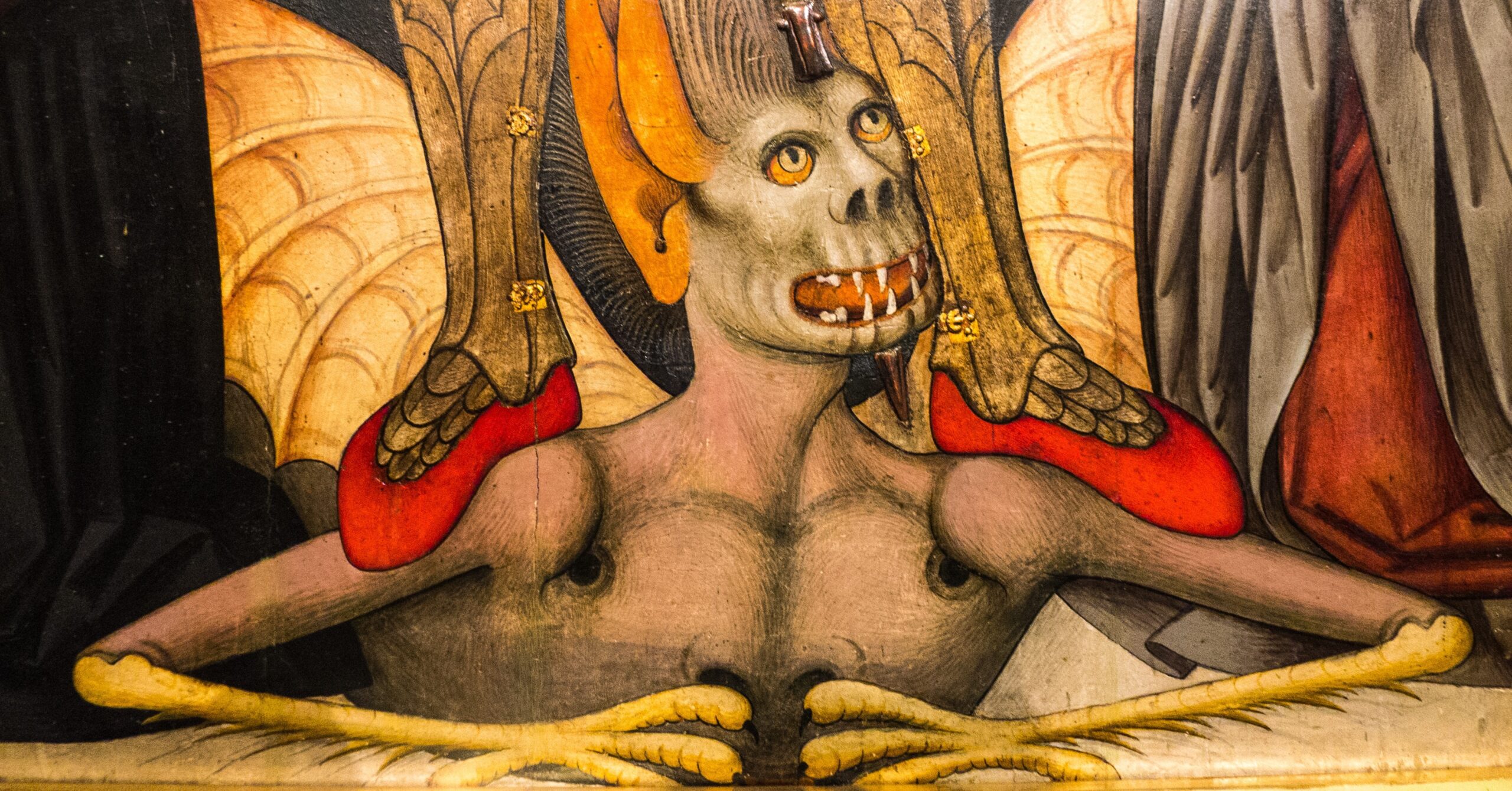
“We cannot avoid this controversial question when we deal with the topic of spiritual warfare. First, we should define what we mean by demon-possessed. Some scholars today prefer the term demonized rather than possessed.1 The objection is that the New Testament does not use the word possessed. Furthermore, the word possessed implies ownership and property. We fervently deny the concept that Satan can own a believer.2 The preferred term, demonized, comes from the Greek word daimonizomai.3 Most English translations retain the term demon-possessed. The parallel expression is “to have a demon/spirit.” “He has a demon” was the accusation made against John the Baptist and Jesus (Matt. 11:18; Luke 7:33; John 7:20; 8:48, 52; 10:20). The Gospels and the book of Acts describe some people as having various kinds of spirits. There are “deaf spirits” (Mark 9:17, 20, 25) and “unclean spirits” (Matt. 12:43; Mark 1:26; 5:8; Luke 11:24). An interesting phrase occurs in Luke 4:33: “Now in the synagogue there was a man who had a spirit of an unclean demon.”4 There is a “spirit of divination” (Acts 16:16). There is an “evil spirit” (Acts 19:15–16).
It seems that there is no distinction between having a demon or spirit and being demonized. The terms indicate that a demon or demons control and even inhabit a person. We can rephrase the question, then: Can a Christian be inhabited and controlled by a demon? Some have answered yes without reservation. Merrill Unger, Mark Bubeck, Fred Dickason, Neil Anderson, Timothy Warner, Ed Murphy, and John Wimber are among those who have taught that this is a possibility.
Clinton Arnold argues for a view of Christian demonization that excludes the concept of being “owned” by a demon.5 However, basing a significant part of his argument on Ephesians 4:27 (“nor give place [topos, or an opportunity] to the devil”),6 Arnold does argue that Christians can be inhabited, influenced, and even dominated by demons.7 What should we think of such a possibility?”
Two truths must be kept together. We have repeated them throughout this book. First, we cannot exaggerate the power of Christ’s person and work. Christ has triumphed over the principalities and powers (Col. 2:15). He has rendered Satan powerless (Heb. 2:14). Because we are in union with Him, we share His victory (Eph. 2:6). That union is demonstrated by our deliverance from the dominion of darkness (Acts 26:18; Col. 1:13). Union with Christ also means that He dwells in us by His Spirit, and we dwell in Him (Rom. 8:9). We are now, indeed, a holy habitation of the Spirit (1 Cor. 6:19–20). The power and glory of Christ’s redemptive work on our behalf and our vital union with Him make demonic inhabitation and control of a Christian impossible (1 John 4:4; 5:18–20). Also, in Matthew 12:43–45, Jesus teaches,”
“When an unclean spirit goes out of a man, he goes through dry places, seeking rest, and finds none. Then he says, “I will return to my house from which I came.” And when he comes, he finds it empty, swept, and put in order. Then he goes and takes with him seven other spirits more wicked than himself, and they enter and dwell there; and the last state of that man is worse than the first. So shall it also be with this wicked generation.8
It appears from this text that an unclean spirit cannot take up residence in a place that is already occupied. Therefore, since the Holy Spirit permanently indwells the believer, this can never happen (Rom. 5:5). The New Testament teaches a radical break, through the redeeming work of Christ, with the power of sin and the power and dominion of Satan (Col. 1:13). We live in a new relationship based on the liberating, renewing, and indwelling work of Christ through His Spirit. However, we must not ignore a second truth. If we do, it will be to our peril. The truth, echoed many times in this work, is that the enemy is real, and he can gain a foothold in our lives and exert considerable influence (Eph. 4:27). How much can he influence a believer? Scripture clearly indicates the influence can be significant. As a roaring lion, Satan seeks to devour, which seems more serious than simply being bit (1 Peter 5:8). The New Testament emphasis is that the devil’s influence on the Christian is primarily deceptive scheming and trickery, not indwelling and controlling.
Furthermore, such a belief can be detrimental to a Christian. It can minimize the magnitude of Christ’s work of redemption, and we see this among those who accept a person’s profession of Christianity, even though that person refuses to repent and lives in overt sin.9 It is also demonstrated by those who diminish the radical rescuing and transforming power of the gospel. It diminishes a person’s sense of responsibility for sin and can distract from the real remedy of battling our sin and the powers of darkness. It can deny the power and sufficiency of Christ and His Word. We are not saying that all who believe in Christian demonization make this mistake, but these are real tendencies.
However, the other extreme—denying or ignoring demonic activity—can be perilous too. A person who lives a life of sin and makes only superficial confessions, with no serious attempts at repentance, may have an unregenerate heart or may be allowing demonic powers to blind his perspectives and influence his thinking. Under such influence, there would be some level of control as well. Again, as we mentioned in the introduction, we cannot afford to fall off either side of this horse. We need a biblical and balanced perspective at all times. Putting on the armor of God, drawing near to God, and resisting the devil are key components in this battle.
“1. See, for example, Grudem, Systematic Theology, 423–25.
2. Arnold, “The Tragic Confusion Surrounding the Word ‘Possession,’” in Three Crucial Questions, 78–81, 138–39.
3. This word occurs in Matthew 4:24; 8:16, 28, 33; 9:32; 12:22; 15:22; Mark 1:32; 5:15, 16, 18; Luke 8:36; John 10:21.
4. This could also be translated “who had a demonic, unclean spirit.”
5. Arnold, Three Crucial Questions, 78. “Can a Christian Be Demon-Possessed” is the second of the three crucial questions (73–141).
6. The term topos can mean a place, a position, a room, or an opportunity.
7. Arnold, Three Crucial Questions, 88–93.
8. For a detailed exposition of this text, see Rob Ventura, “The Delusion of Mere Moral Reformation,” Sermonaudio.com, http://www.sermonaudio.com/sermoninfo.asp?SID=527121443495.
9. This is a consistent weakness in Neil Anderson’s works; he uncritically accepts all as Christians who claim to be, even if their lives do not show the fruit of conversion.”
- Excerpt From the Book Spiritual Warfare by Brian Borgman and Rob Ventura;
This material may be protected by copyright.






Leave A Comment